Born in 1956: fun facts, prices and a free printable 70th birthday party kit
Turning 70 in 2026? Here is their birth year, from Elvis on TV to the Interstate highways, plus a free printable party kit.
In 1956 Dwight Eisenhower won a second term and signed the Interstate Highway Act. Elvis Presley's "Don't Be Cruel" topped Cash Box's year-end chart, Grace Kelly married Prince Rainier, and Don Larsen threw a perfect game in the World Series. Melbourne hosted the Summer Olympics, and The Wizard of Oz aired on TV for the first time.
Anyone born in 1956 arrived in the year Elvis Presley first appeared on The Ed Sullivan Show, Eisenhower won a second term and Congress funded the Interstate highways. Don Larsen threw a perfect game in the World Series, and Melbourne hosted the Olympics.
Below you will find the year's major events, what groceries cost and who shares the birth year, along with the movies, songs and TV of the moment. The page closes with party ideas and a free printable kit of 1956 trivia and games for signed-in visitors.
What’s in the free printable Born in 1956 party kit?
27 printable pages in 3 PDFs for the 70th birthday party: 12 games, a host guide with every answer, and table cards. Print it at home, hand out pens and let the stories start.
- Meet & mingle bingo
- The 1956 headline quiz
- What did it cost in 1956?
- The 1956 birthday club
- Movies & music of 1956
- Before or after 1956?
- Timeline shuffle
- The 1956 word search
- Who knows them best?
- Two truths & a tall tale
- Toasts & memory prompts
- Wishes for the next chapter
Free printable PDFs with an InviteBird account: 3 files, each in US Letter and A4.
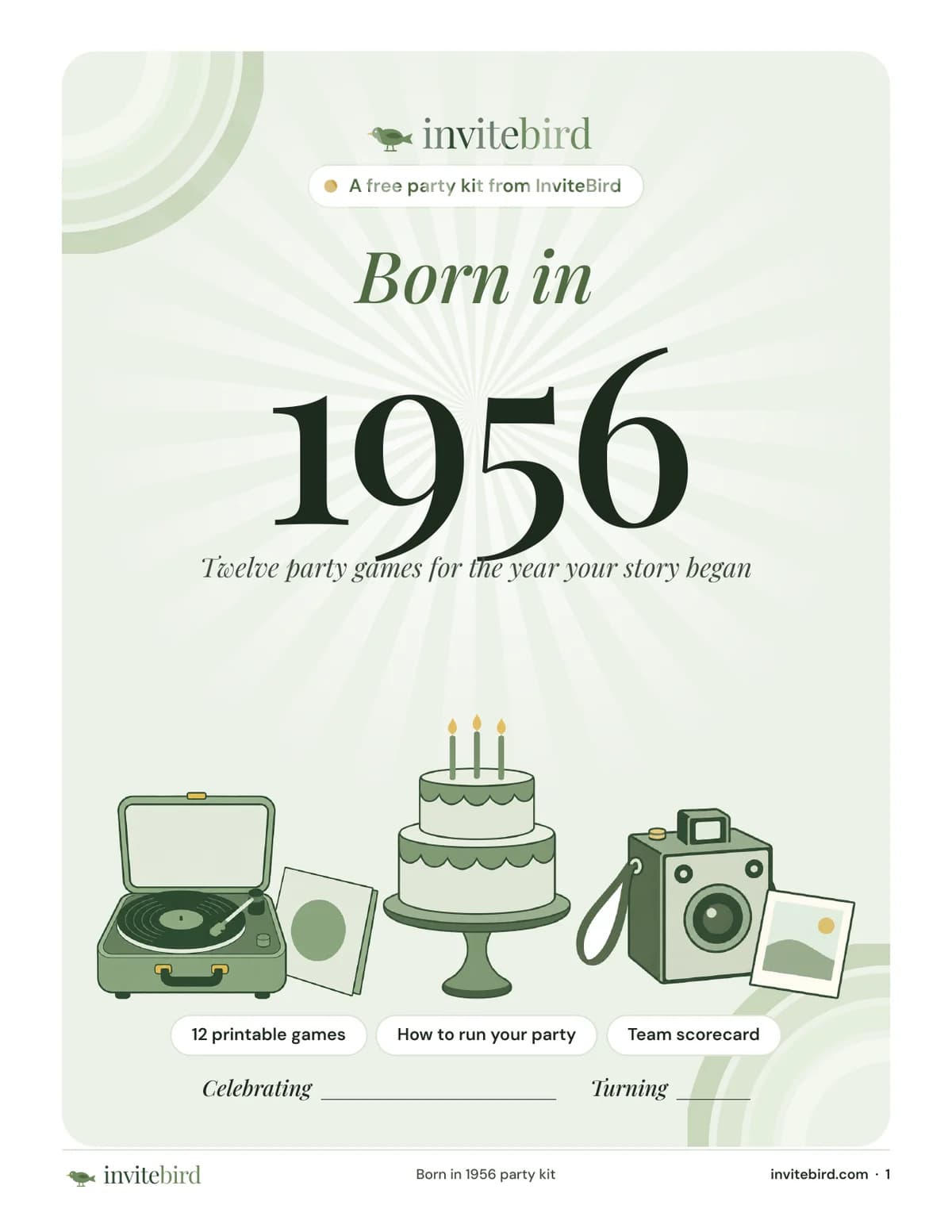
A look inside the kit
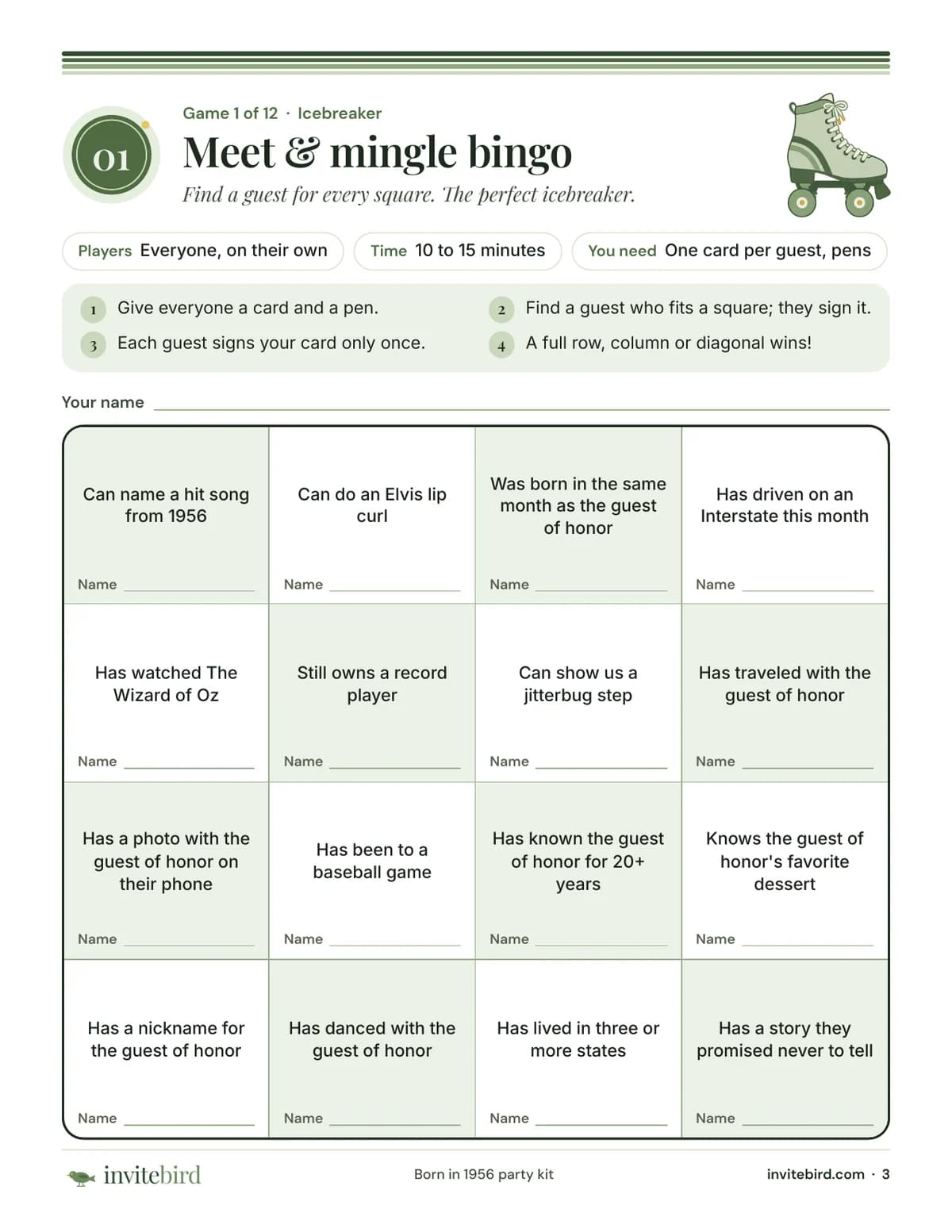
Game 1: Meet & mingle bingo
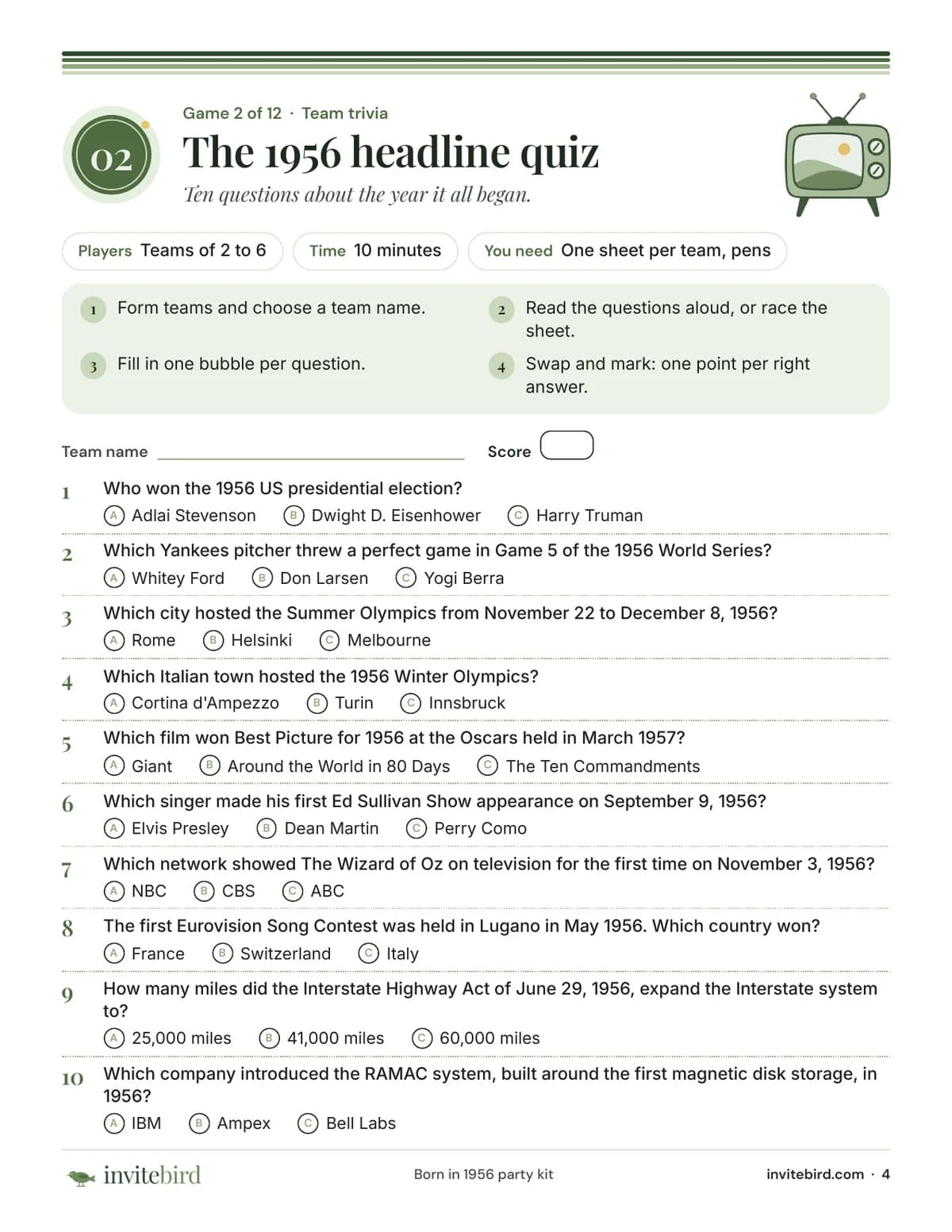
Game 2: The 1956 headline quiz
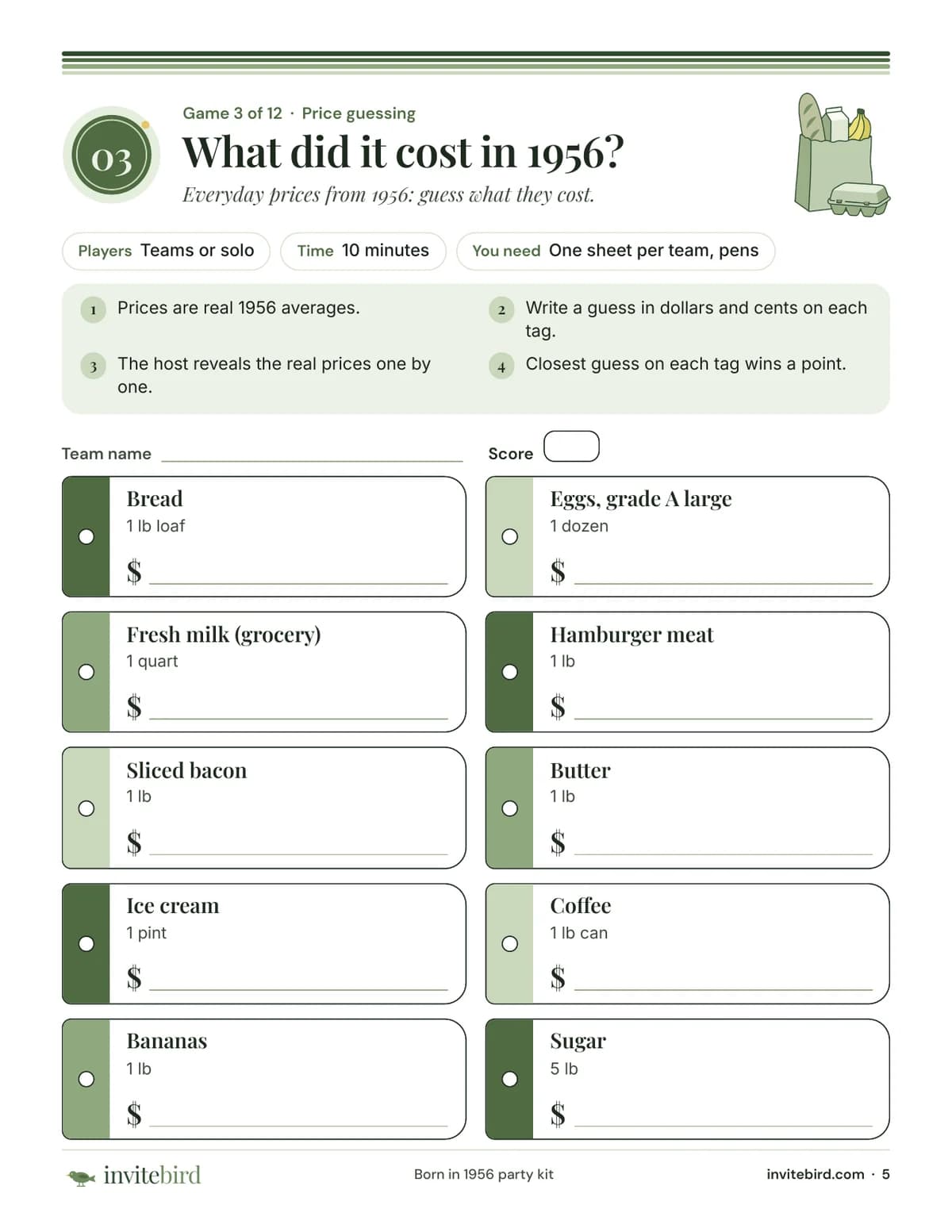
Game 3: What did it cost in 1956?
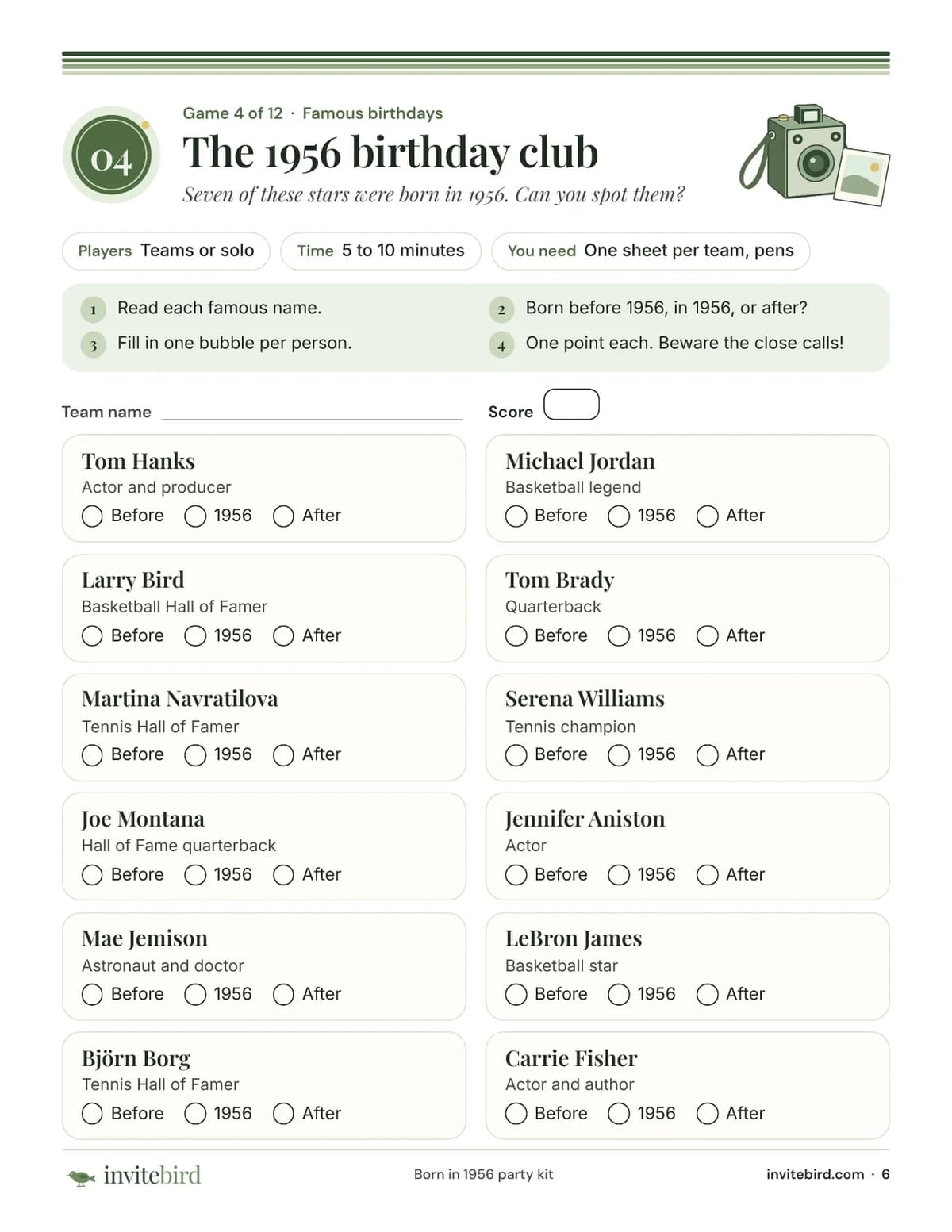
Game 4: The 1956 birthday club
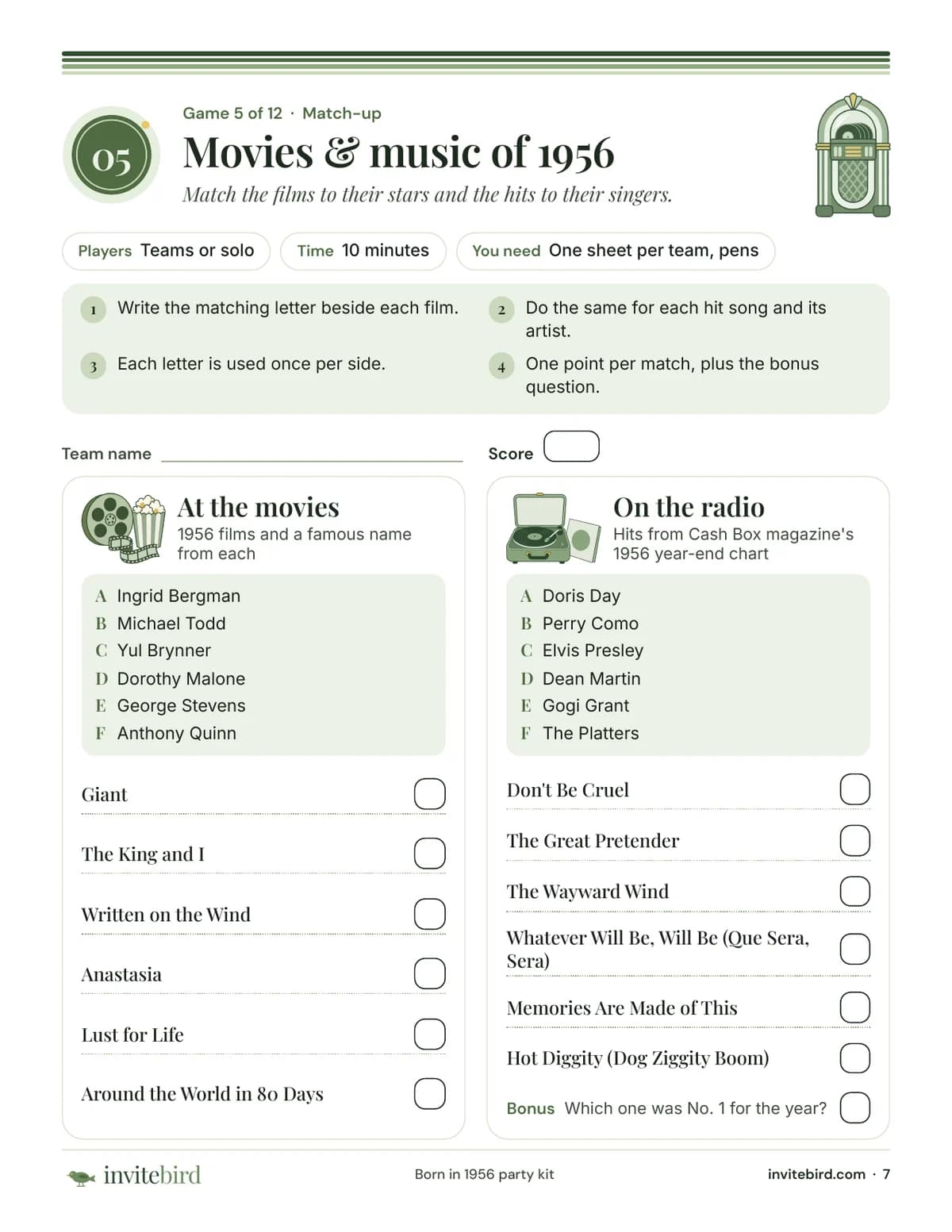
Game 5: Movies & music of 1956
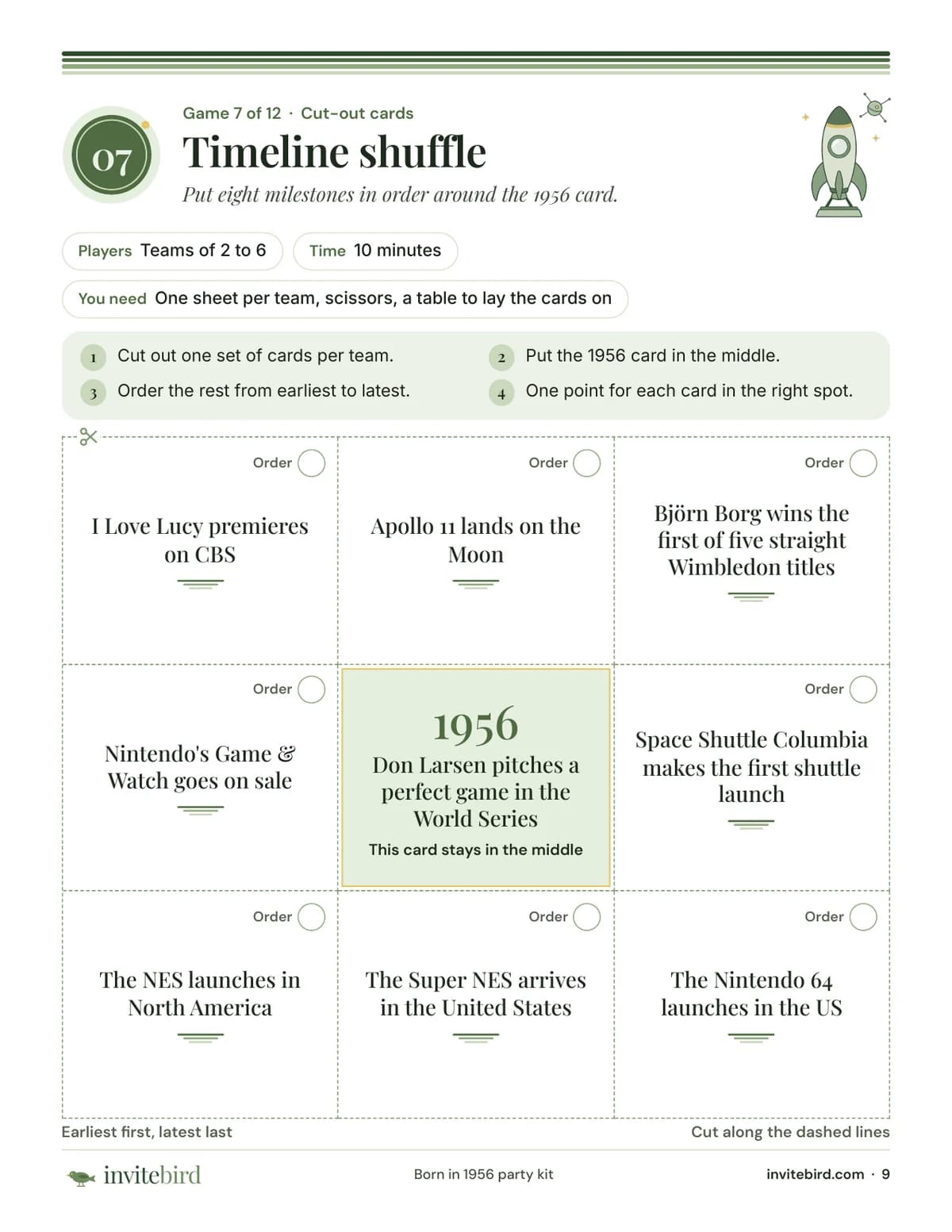
Game 7: Timeline shuffle
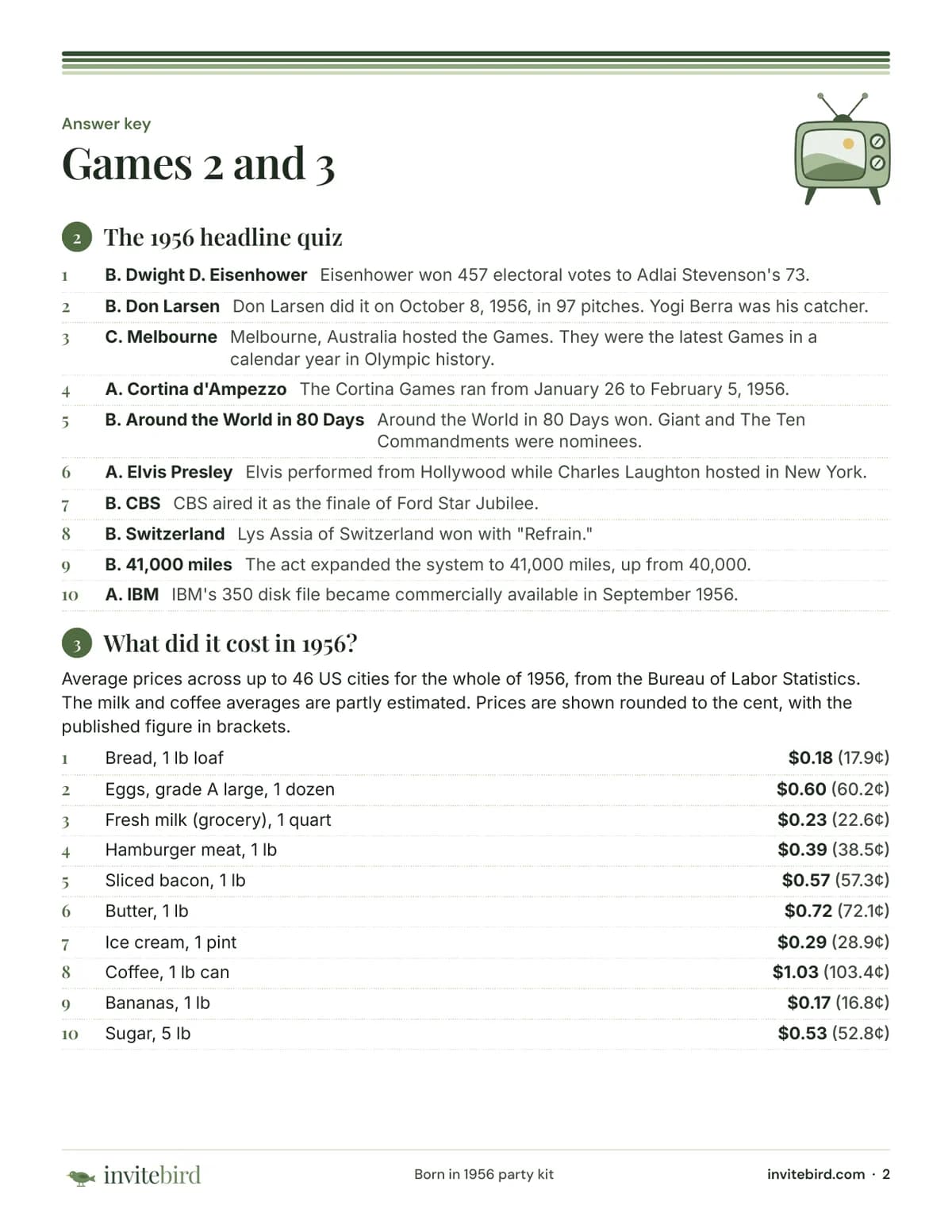
The host guide: every answer, explained
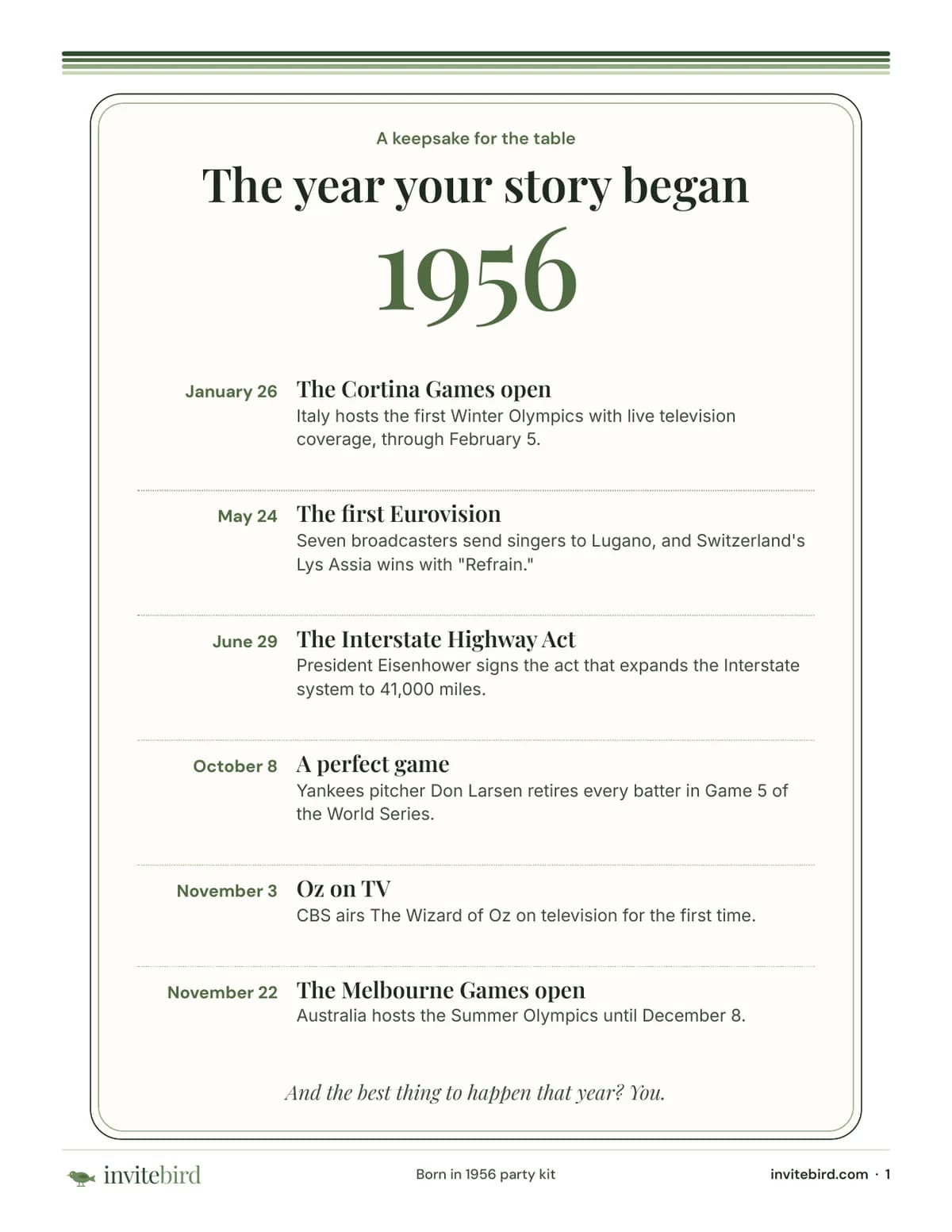
Table cards: the 1956 history card, welcome sign and place cards
How do you play the 70th birthday party games in the kit?
Here is what each game asks of your guests, how to play it and why it lands, so you can pick the ones that suit your crowd before you print.
Meet & mingle bingo
Find a guest for every square. The perfect icebreaker.
You need
- One card per guest
- Pens
How to play
- Hand everyone a card and a pen as they arrive.
- Mingle! When a guest fits a square, ask them to sign their name in it.
- Each guest can sign your card only once. The guest of honor may sign twice.
- First to fill a row, column or diagonal calls "Bingo!" and the host checks the names.
Why it’s fun: Strangers become friends in minutes, and everyone ends up swapping stories about the guest of honor.
The 1956 headline quiz
Ten questions about the year it all began.
You need
- One sheet per team
- Pens
How to play
- Split into teams and pick a team name.
- Read each question aloud, or let teams work through the sheet at their own pace.
- Fill in one bubble per question. Changed your mind? Cross it out clearly.
- Swap sheets to mark them: one point per right answer. Answers are in the host guide.
Why it’s fun: Big moments from 1956, with answers that spark "I remember that!" stories.
What did it cost in 1956?
Everyday prices from 1956: guess what they cost.
You need
- One sheet per team
- Pens
How to play
- Every price is a real 1956 figure; the host guide says where each one comes from.
- Write your best guess in dollars and cents on each tag.
- The host reveals the real prices one at a time, for maximum gasps.
- The closest guess on each tag wins a point. For extra drama, play closest without going over.
Why it’s fun: Everyone has an opinion about prices, and the real 1956 numbers always get a reaction.
The 1956 birthday club
Seven of these stars were born in 1956. Can you spot them?
You need
- One sheet per team
- Pens
How to play
- Read each famous name.
- Decide whether they were born before 1956, in 1956, or after 1956.
- Fill in one bubble for each person.
- One point per right answer. Watch out for the close calls!
Why it’s fun: Quick to play and full of surprises: it is hard to believe some of these stars share the guest of honor's birth year.
Movies & music of 1956
Match the films to their stars and the hits to their singers.
You need
- One sheet per team
- Pens
How to play
- Match each film to a famous name from the box, writing the letter beside it.
- Do the same for each 1956 hit song and its artist.
- Each letter is used once per side.
- One point per match, plus a bonus point for naming the song that was No. 1 on Cash Box magazine's 1956 year-end chart.
Why it’s fun: It turns into a sing-along. Play the songs as you reveal the answers.
Before or after 1956?
Toys, games and gadgets: did each arrive before or after 1956?
You need
- One sheet per team
- Pens
How to play
- Read each milestone.
- Fill in the bubble on the left for before 1956, or on the right for after 1956.
- None of these happened in 1956 itself.
- One point per right answer. Some of them are very close calls!
Why it’s fun: Everyone has a memory of these, and the close calls start friendly arguments.
Timeline shuffle
Put eight milestones in order around the 1956 card.
You need
- One sheet per team
- Scissors
- A table to lay the cards on
How to play
- Before the party, cut out one set of cards per team along the dashed lines.
- Each team lays the 1956 card in the middle of their table.
- Place the other eight cards in order from earliest to latest, around the 1956 card.
- The host reads out the right order: one point for each card in the right spot.
Why it’s fun: Hands-on and loud: teams debate, shuffle and change their minds right up to the reveal.
The 1956 word search
Fifteen words from 1956 are hidden in the grid.
You need
- One sheet per player
- Pens or pencils
How to play
- Find each word from the list in the grid.
- Words run across, down or diagonally, and some run backwards.
- Circle each word in the grid and tick it off the list.
- First to find all fifteen wins. The solution is in the host guide.
Why it’s fun: A calm game for anyone who wants a break from the crowd, including the youngest guests.
Who knows them best?
How well do you really know the guest of honor?
You need
- One sheet per team
- Pens
- The guest of honor's answers
How to play
- Before the party, ask the guest of honor to answer the questions privately.
- Teams write down what they think the guest of honor said.
- The guest of honor reveals each answer, with the story behind it.
- One point per match. The host decides on close answers.
Why it’s fun: The reveals are the best part: every answer comes with a story.
Two truths & a tall tale
Two true stories and one invention. Spot the tall tale.
You need
- One slip per guest (two per sheet)
- Pens
How to play
- Write three short statements about yourself: two true, one made up.
- Fill in the bubble for your tall tale, then fold that corner over to hide it.
- Take turns reading your three statements aloud.
- Everyone guesses the tall tale. Fool the room and you win a point.
Why it’s fun: Guests learn surprising things about each other, and the guest of honor's turn is always a highlight.
Toasts & memory prompts
Twelve prompts that turn shy guests into storytellers.
You need
- One sheet, cut into cards
- A bowl or hat
How to play
- Cut the cards apart along the dashed lines and put them in a bowl.
- When it is time for toasts, pass the bowl around.
- Draw a card and finish the sentence, out loud, to the guest of honor.
- Raise a glass after each one. No points, just good stories.
Why it’s fun: Nobody has to prepare a speech, yet everyone ends up saying something lovely.
Wishes for the next chapter
A keepsake card for every guest to fill in.
You need
- One card per guest (two per sheet)
- Pens
- A box or envelope to collect them
How to play
- Cut each sheet in half along the dashed line.
- Put the cards out on a table with pens, or hand them out at the start.
- Guests write a wish, a memory and their name.
- Collect them in a box for the guest of honor to read later.
Why it’s fun: The one thing from the party the guest of honor will keep for years.
How do you run the kit at a 70th birthday party?
Example: a 90-minute 70th birthday party for 16 guests, born-in-1956 style, in four teams of four. Swap games in or out to suit your crowd; the host guide has every answer.
Before the party, print
- 16 bingo cards, one per guest
- 4 copies each of the headline quiz, the price game, the birthday club, Movies & music and Before or after
- 4 timeline sheets, cut into cards
- 8 two-truths sheets and 8 wish-card sheets (two per sheet)
- The toast prompts, the scorecard and the host guide
- The table cards: the 1956 history card, the welcome sign and four sheets of place cards
- 0:00Guests arrive: Meet & mingle bingo
Hand each guest a bingo card and a pen at the door, so the mingling starts before the coats are off.
- 0:15Welcome and teams
Say a few words about the guest of honor, then split the room into four teams of four, mixing generations.
- 0:20Round one: The 1956 headline quiz and What did it cost in 1956?
Read the quiz aloud, then reveal the real prices one at a time and let the gasps do the work.
- 0:40Round two: The 1956 birthday club and Movies & music of 1956
Play a few seconds of each song while teams match the hits to their singers.
- 0:55Cake break: The 1956 word search and Wishes for the next chapter
Leave the word search and the wish cards on the tables while everyone eats.
- 1:05Round three: Before or after 1956? and Timeline shuffle
Hand each team its set of timeline cards and give them five minutes to argue.
- 1:20All about them: Who knows them best? and Two truths & a tall tale
Reveal the guest of honor's private answers, then let them read their two truths last.
- 1:30Toasts and winners: Toasts & memory prompts
Pass the bowl of toast prompts, add up the scorecard and crown the winning team.
What happened in 1956?
The biggest events of 1956, each with the source it comes from.
- January 26-February 5
Winter Olympics in Cortina d'Ampezzo
Cortina d'Ampezzo, Italy, hosted the Winter Games with 821 athletes from 32 nations. They were the first Winter Olympics with live television coverage and the first to include athletes from the Soviet Union.
Source: Canadian Olympic Committee: Cortina d'Ampezzo 1956 - March 1
The minimum wage rises to $1.00
The federal minimum wage went from 75 cents to $1.00 an hour.
Source: U.S. Department of Labor: History of Federal Minimum Wage Rates, 1938-2009 - April 19
Grace Kelly marries Prince Rainier
The American film star married Prince Rainier III of Monaco at St. Nicholas Cathedral, with about 700 guests. More than 30 million people watched on live television. A civil ceremony was held the day before.
Source: HISTORY: Grace Kelly and Prince Rainier of Monaco marry in 'wedding of the century' - May 24
The first Eurovision Song Contest
Seven broadcasters took part in the first contest, held at the Teatro Kursaal in Lugano, Switzerland. Switzerland's Lys Assia won with "Refrain."
Source: Eurovision Song Contest: Lugano 1956 - June 29
The Interstate Highway Act is signed
President Eisenhower signed the act that expanded the Interstate system to 41,000 miles and authorized $25 billion for fiscal years 1957 through 1969. The National Archives calls it the biggest public works project in the nation's history.
Source: National Archives: National Interstate and Defense Highways Act (1956) - September 4
IBM's disk drive reaches customers
The IBM 350 disk file, the heart of the RAMAC 305 system, became commercially available. It was the industry's first magnetic disk file and held 5 million characters.
Source: ETHW (IEEE): Milestones: RAMAC, 1956 - September 9
Elvis on The Ed Sullivan Show
Elvis Presley made his first appearance on the show, performing from Hollywood while Charles Laughton hosted in New York. About 60 million people watched.
Source: Graceland: Celebrating Elvis Presley's First Appearance on The Ed Sullivan Show (September 9, 1956) - September 25
TAT-1 opens transatlantic phone service
The first transatlantic telephone cable, running between Scotland and Newfoundland, opened for business with 36 telephone channels. In its first 24 hours it carried 588 calls between London and the US and 119 between London and Canada.
Source: Guinness World Records: First transatlantic telephone call - October 8
Don Larsen pitches a perfect game
In Game 5 of the World Series, Yankees pitcher Don Larsen retired every Brooklyn batter he faced, using 97 pitches. Pinch hitter Dale Mitchell was the last out, with Yogi Berra catching.
Source: Baseball Hall of Fame: Don Larsen defined World Series perfection - November 3
The Wizard of Oz comes to TV
CBS aired the film uncut in a two-hour slot as the finale of Ford Star Jubilee. Bert Lahr, the Cowardly Lion, introduced it with Liza Minnelli. Better than 45 million people were estimated to be watching.
Source: OZ Museum: Is this the road to Iconic? - November
Eisenhower wins a second term
Dwight Eisenhower defeated Adlai Stevenson, taking 457 electoral votes to Stevenson's 73.
Source: National Archives: 1956 Electoral College Results - November 13
Supreme Court upholds the ruling on Montgomery's buses
The U.S. Supreme Court affirmed the ruling in Browder v. Gayle that segregation on public buses was unconstitutional. The Montgomery bus boycott lasted 381 days in all.
Source: National Archives: An Act of Courage, The Arrest Records of Rosa Parks - November 22-December 8
The Melbourne Olympics
Australia hosted the Summer Games, with 3,155 athletes from 67 national Olympic committees. They were the latest Games in a calendar year in Olympic history.
Source: Canadian Olympic Committee: Melbourne 1956 - November 30
Videotape makes its TV debut
CBS Television City in Hollywood recorded the Douglas Edwards news from a live New York feed on an Ampex machine and replayed it for viewers in twelve western cities.
Source: Television Academy Foundation: 50 Years Ago -- Videotape Debuts
How much did things cost in 1956?
A snapshot of the cost of living in 1956, from a stamp to a pound of coffee. Every price is a US figure from a government source.

What was popular in 1956?

Movies
- Around the World in 80 Days
Michael Todd's travel epic won Best Picture at the 29th Academy Awards, held on March 27, 1957.
Source: Academy of Motion Picture Arts and Sciences: The 29th Academy Awards (1957) - The King and I
Yul Brynner won Best Actor for playing the King of Siam. The musical was also a Best Picture nominee.
Source: Academy of Motion Picture Arts and Sciences: The 29th Academy Awards (1957) - Anastasia
Ingrid Bergman won Best Actress for the film. Cary Grant accepted the Oscar on her behalf.
Source: Academy of Motion Picture Arts and Sciences: The 29th Academy Awards (1957) - Giant
George Stevens won Best Director for this Texas family saga, which was also nominated for Best Picture.
Source: Academy of Motion Picture Arts and Sciences: The 29th Academy Awards (1957) - The Ten Commandments
Cecil B. DeMille's biblical epic was one of the five Best Picture nominees for 1956 films.
Source: Academy of Motion Picture Arts and Sciences: The 29th Academy Awards (1957)
Music
- "Don't Be Cruel" by Elvis Presley
It took the No. 1 spot on Cash Box magazine's year-end singles chart for 1956. Elvis's "Heartbreak Hotel" ranked sixth.
Source: Cash Box magazine archive: Cash Box YE Singles (Pop) 1956 - "The Great Pretender" by The Platters
The Platters took the second spot with this song and the third with "My Prayer."
Source: Cash Box magazine archive: Cash Box YE Singles (Pop) 1956 - "The Wayward Wind" by Gogi Grant
Grant's ballad finished fourth on the year-end chart.
Source: Cash Box magazine archive: Cash Box YE Singles (Pop) 1956 - "Whatever Will Be, Will Be (Que Sera, Sera)" by Doris Day
Day's song was the fifth biggest single of the year on Cash Box's chart.
Source: Cash Box magazine archive: Cash Box YE Singles (Pop) 1956
TV shows
- The Wizard of Oz on CBS
The movie aired on television for the first time on Saturday, November 3, from 9 to 11 p.m. Eastern.
Source: OZ Museum: Is this the road to Iconic? - Elvis on The Ed Sullivan Show
Presley sang "Don't Be Cruel," "Love Me Tender," "Ready Teddy" and a few verses of "Hound Dog."
Source: Graceland: Celebrating Elvis Presley's First Appearance on The Ed Sullivan Show (September 9, 1956) - I Love Lucy
When weekly production ended in 1957, it was still the country's top series. It had been the highest-rated show on television in four of its six prime-time seasons.
Source: Television Academy Foundation, The Interviews: I Love Lucy
Sport
- Don Larsen's perfect game
On October 8 the Yankees' Don Larsen was perfect in Game 5 of the World Series, striking out Dale Mitchell to end it.
Source: Baseball Hall of Fame: Don Larsen defined World Series perfection - Mickey Mantle's Triple Crown
The Yankees' Mantle hit .353 with 52 home runs and 130 RBI and won the first of two straight American League MVP awards.
Source: Baseball Hall of Fame: Mantle, Mickey - Toni Sailer sweeps the Alps
Austria's Toni Sailer won all three men's alpine skiing events at the Cortina Winter Games.
Source: Canadian Olympic Committee: Cortina d'Ampezzo 1956 - One team at the closing ceremony
At Melbourne, athletes began marching into the stadium together instead of by country, after a letter from a 17-year-old apprentice named John Ian Wing.
Source: Canadian Olympic Committee: Melbourne 1956
Technology
- Videotape
Ampex's VRX-1000 was a machine the size of a wall that recorded onto two-inch magnetic tape. CBS installed two and taped on both as a backup.
Source: Television Academy Foundation: 50 Years Ago -- Videotape Debuts
Which famous people were born in 1956?
A few familiar faces who share the birth year, all born in 1956.
- May 17, 1956Bob SagetComedian and actor: Danny Tanner on Full House and the host of America's Funniest Home Videos.Source: Biography.com: Bob Saget
- June 6, 1956Björn BorgSwedish tennis champion who won Wimbledon five years in a row, 1976 to 1980, and the French Open six times.Source: International Tennis Hall of Fame: Björn Borg
- June 11, 1956Joe MontanaHall of Fame quarterback who won four Super Bowls with the San Francisco 49ers. His nickname was "Joe Cool."Source: Biography.com: Joe Montana
- July 9, 1956Tom HanksActor who won back-to-back Best Actor Oscars for Philadelphia and Forrest Gump and voices Woody in Toy Story.Source: Biography.com: Tom Hanks
- October 17, 1956Mae JemisonDoctor and astronaut who flew aboard the space shuttle Endeavour in 1992 as the first Black woman in space.Source: Biography.com: Mae Jemison
- October 18, 1956Martina NavratilovaTennis champion with 18 Grand Slam singles titles, including nine at Wimbledon, and 59 Grand Slam titles in all.Source: International Tennis Hall of Fame: Martina Navratilova
- October 21, 1956Carrie FisherActor and author who played Princess Leia in the Star Wars films and wrote the 1987 novel Postcards from the Edge.Source: Biography.com: Carrie Fisher
- December 7, 1956Larry BirdBoston Celtics forward drafted sixth overall, a three-time NBA MVP and a member of the 1992 Dream Team.Source: Biography.com: Larry Bird
What are some fun facts about 1956?
The 1956 Olympic equestrian events were held in Stockholm in June, because Australia required a six-month quarantine for foreign horses. That put them in a different country, on a different continent and in a different season from the rest of the Games.
Source: Canadian Olympic Committee: Melbourne 1956Athletes marching into the Melbourne closing ceremony as one group was the idea of a 17-year-old apprentice carpenter, John Ian Wing. His letter said that "War, politics, and nationality will be all forgotten."
Source: Canadian Olympic Committee: Melbourne 1956Elvis was in Hollywood filming Love Me Tender when he made his first Ed Sullivan appearance. Sullivan was recovering from a car crash, so British actor Charles Laughton filled in as host.
Source: Graceland: Celebrating Elvis Presley's First Appearance on The Ed Sullivan Show (September 9, 1956)IBM's RAMAC disk file stored 5 million characters of 6 bits each. Computers of the time did not yet group bits into 8-bit bytes.
Source: ETHW (IEEE): Milestones: RAMAC, 1956Bert Lahr's live introduction to The Wizard of Oz on TV, with Liza Minnelli, went out live, and no film of it exists.
Source: OZ Museum: Is this the road to Iconic?The Interstate law renamed the network the "National System of Interstate and Defense Highways." Congress expected it to take thirteen years to finish.
Source: National Archives: National Interstate and Defense Highways Act (1956)Each country sent two songs to the first Eurovision. Lys Assia performed both of Switzerland's, "Refrain" and "Das Alte Karussell," and won with "Refrain."
Source: Eurovision Song Contest: Lys Assia, Lugano 1956Don Larsen threw only 97 pitches in his perfect game, and the last out was a strikeout of pinch hitter Dale Mitchell.
Source: Baseball Hall of Fame: Don Larsen defined World Series perfectionAt Cortina the Soviet Union competed at a Winter Games for the first time and was housed apart from the other delegations.
Source: Canadian Olympic Committee: Cortina d'Ampezzo 1956
Can you answer these 1956 trivia questions?
Tap a question to see the answer. The party kit has a full round of 1956 trivia ready to print.
Who won the US presidential election in 1956?
Answer: Dwight D. Eisenhower, with 457 electoral votes to Adlai Stevenson's 73. Source: National Archives: 1956 Electoral College Results
Which Yankees pitcher threw a perfect game in the 1956 World Series?
Answer: Don Larsen, on October 8 in Game 5 against Brooklyn. Source: Baseball Hall of Fame: Don Larsen defined World Series perfection
Which city hosted the Summer Olympics from November 22 to December 8, 1956?
Answer: Melbourne, Australia. Source: Canadian Olympic Committee: Melbourne 1956
Which film won Best Picture for 1956 at the Oscars ceremony in March 1957?
Answer: Around the World in 80 Days. Source: Academy of Motion Picture Arts and Sciences: The 29th Academy Awards (1957)
Which singer made his first Ed Sullivan Show appearance on September 9, 1956?
Answer: Elvis Presley, who sang "Don't Be Cruel" among other songs. Source: Graceland: Celebrating Elvis Presley's First Appearance on The Ed Sullivan Show (September 9, 1956)
Which network showed The Wizard of Oz on television for the first time on November 3, 1956?
Answer: CBS. Source: OZ Museum: Is this the road to Iconic?
How much did it cost to mail a first-class letter in 1956?
Answer: 3 cents for the first ounce. Source: USPS Postal History: Rates for Domestic Letters Since 1863
Which country won the first Eurovision Song Contest in Lugano in May 1956?
Answer: Switzerland, with Lys Assia singing "Refrain." Source: Eurovision Song Contest: Lugano 1956
What did the federal minimum wage rise to on March 1, 1956?
Answer: $1.00 an hour, up from 75 cents. Source: U.S. Department of Labor: History of Federal Minimum Wage Rates, 1938-2009
Which company introduced the RAMAC computer system with the first magnetic disk storage in 1956?
Answer: IBM. Source: ETHW (IEEE): Milestones: RAMAC, 1956
How do you throw a 1956-themed 70th birthday party?

Spin the 1956 hits
Build a playlist from Cash Box's year-end chart: "Don't Be Cruel," "The Great Pretender," "The Wayward Wind" and "Que Sera, Sera." Add "Heartbreak Hotel" and "Memories Are Made of This" for the slow dance.
Name-that-tune showdown
Play a few seconds of each record and let tables race to name the song and the singer. Anyone who can finish the chorus earns a bonus point.
A soda-shop table
Set up a milkshake and root beer float bar with striped straws and cherries. Serve deviled eggs, mini burgers and a classic ice cream cake.
Backyard perfect game
Give a nod to Don Larsen with a pitching contest: set up a target, hand out a bucket of soft balls and see who can hit it most often. The winner gets a trophy and a cheer.
Dress code: 1956
Ask guests to come in 1950s style: poodle skirts, rolled-cuff jeans, a pompadour or a Yankees cap. Prizes go to the best Elvis and best Grace Kelly.
Your own Eurovision
In honor of the first Eurovision Song Contest, let teams perform a short song for the guest of honor and score them out of ten. Seven acts makes a tidy first round.
Then-and-now photo wall
Line one wall with baby photos from 1956 next to a few of that year's headlines: Elvis on TV, a perfect game, the new highways. Hang recent snapshots at the far end so guests can walk through the decades.
Guess the 1956 price
Write milk, eggs and gas on cards and ask each guest to guess what they cost in 1956. Check the answers against the prices table above, closest guess wins.
Which invitations and cards fit a 70th birthday?
Born in 1956 means turning 70 in 2026. These designs follow the calendar: next year this page shows 71st birthday picks instead.
70th birthday invitations
All 33 70th birthday invitations
What else do people ask about 1956?
How old is someone born in 1956?
A person born in 1956 turns 70 in 2026. Before the birthday arrives this year, they are a year younger.
What generation is someone born in 1956?
Baby Boomers. Pew Research Center places the Boomer generation between the post-war birth surge that began in 1946 and the sharp drop in births after 1964.
What is the Chinese zodiac sign for 1956?
The Monkey (Fire Monkey). The Year of the Monkey began on February 12, 1956. Anyone born from January 1 to February 11, 1956, is a Goat.
What happened in 1956?
Eisenhower won re-election and signed the Interstate Highway Act. Grace Kelly married Prince Rainier, the first Eurovision Song Contest took place, Don Larsen pitched a perfect game and Melbourne hosted the Summer Olympics.
What was the No. 1 song of 1956?
Elvis Presley's "Don't Be Cruel" was the top single of the year on Cash Box magazine's year-end chart. The Platters' "The Great Pretender" came second and Gogi Grant's "The Wayward Wind" fourth.
How much did things cost in 1956?
A first-class stamp cost 3 cents and the federal minimum wage reached $1.00 an hour in March. Regular gas averaged 29.9 cents a gallon, a pound of bread 17.9 cents and a dozen eggs 60.2 cents.
Which famous people were born in 1956?
Bob Saget, Björn Borg, Joe Montana, Tom Hanks, Mae Jemison, Martina Navratilova, Carrie Fisher and Larry Bird were all born in 1956.
What movies came out in 1956?
Around the World in 80 Days, The King and I, Anastasia, Giant and The Ten Commandments were among the films honored at the Oscars for 1956. Around the World in 80 Days won Best Picture.
What games can you play at a 1956 birthday party?
The free kit has twelve printable games, including bingo, a 1956 headline quiz, a prices game and a word search. A host guide with every answer and a set of table cards come with it. Signed-in visitors can download it from this page.
Where do these facts come from?
- Canadian Olympic Committee: Cortina d'Ampezzo 1956
- U.S. Department of Labor: History of Federal Minimum Wage Rates, 1938-2009
- HISTORY: Grace Kelly and Prince Rainier of Monaco marry in 'wedding of the century'
- Eurovision Song Contest: Lugano 1956
- National Archives: National Interstate and Defense Highways Act (1956)
- ETHW (IEEE): Milestones: RAMAC, 1956
- Graceland: Celebrating Elvis Presley's First Appearance on The Ed Sullivan Show (September 9, 1956)
- Guinness World Records: First transatlantic telephone call
- Baseball Hall of Fame: Don Larsen defined World Series perfection
- OZ Museum: Is this the road to Iconic?
- National Archives: 1956 Electoral College Results
- National Archives: An Act of Courage, The Arrest Records of Rosa Parks
- Canadian Olympic Committee: Melbourne 1956
- Television Academy Foundation: 50 Years Ago -- Videotape Debuts
- USPS Postal History: Rates for Domestic Letters Since 1863
- EIA Annual Energy Review, Table 5.24: Retail Motor Gasoline and On-Highway Diesel Fuel Prices
- US Bureau of Labor Statistics, Bulletin No. 1217: Retail Prices of Food, 1955-56 (Table 9)
- Biography.com: Bob Saget
- International Tennis Hall of Fame: Björn Borg
- Biography.com: Joe Montana
- Biography.com: Tom Hanks
- Biography.com: Mae Jemison
- International Tennis Hall of Fame: Martina Navratilova
- Biography.com: Carrie Fisher
- Biography.com: Larry Bird
- Academy of Motion Picture Arts and Sciences: The 29th Academy Awards (1957)
- Cash Box magazine archive: Cash Box YE Singles (Pop) 1956
- Television Academy Foundation, The Interviews: I Love Lucy
- Baseball Hall of Fame: Mantle, Mickey
- Eurovision Song Contest: Lys Assia, Lugano 1956
The party kit lists the sources behind its games and answers at the back of its host guide.
Planning the 70th?
Pick an invitation, add the details and send it in minutes. Guests RSVP with one tap.
See 70th birthday invitations