RSVP meaning: what it stands for & how to reply
RSVP stands for the French phrase répondez s'il vous plaît, which means "please respond." On an invitation, it asks you to tell the host whether you're coming, yes or no, by the date shown and in the way the invitation asks. The one exception is "regrets only": then you reply only if you can't go.
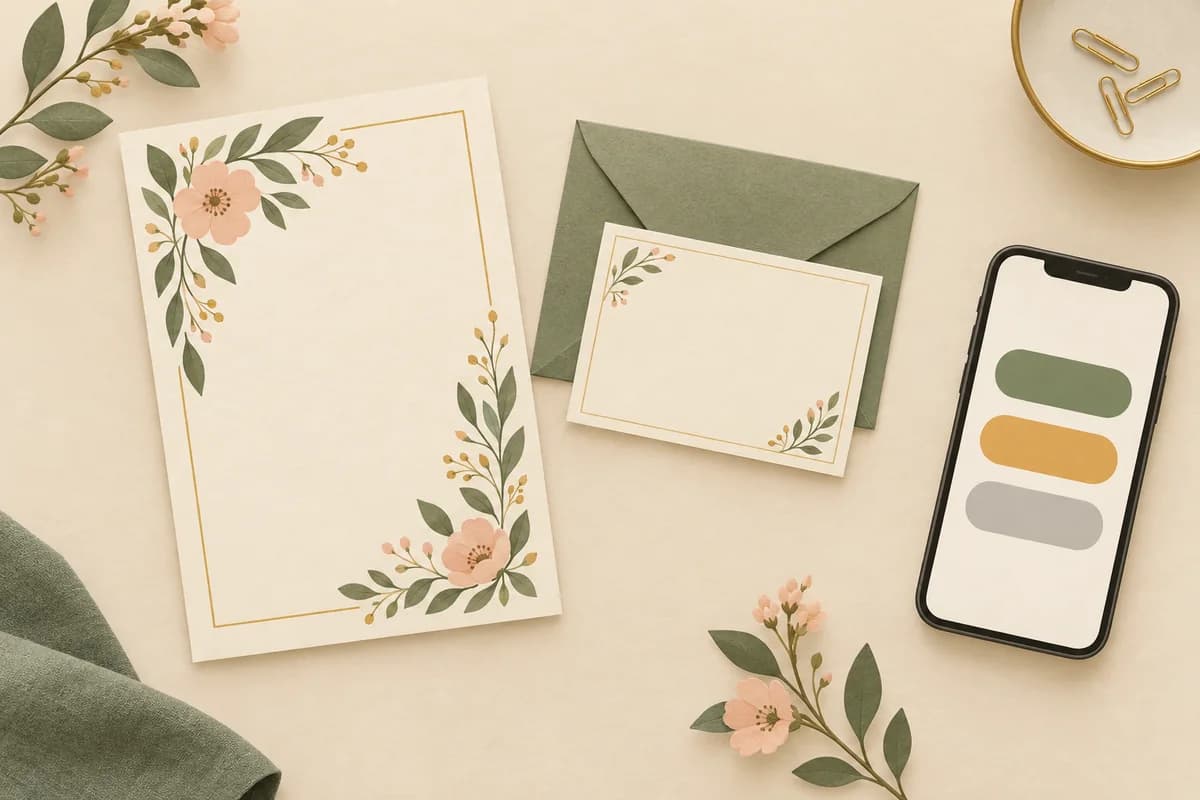
Digital illustration. A reply can travel on a paper card or through a link on your phone; either way, the host is asking for a yes or a no.
- Paper reply card
- Fill in your name and whether you are attending, then mail it back.
- Phone link
- Choose yes, maybe or no on the invitation link.
- RSVP is French for please respond: tell the host yes or no by their date, in the way the invitation asks.
- Reply even when the answer is no, unless the invitation says regrets only.
- Bring only the people the invitation names, and tell the host right away if your plans change.
Five RSVP rules for any invitation
These five rules cover almost every invitation, from a wedding card to a text about a barbecue.
- Reply either way. Respond even when you're not attending: a "no" helps the host plan as much as a "yes."
- Reply soon. Answer as soon as you know, and always before any "RSVP by" date.
- Use the method on the invitation. Reply by the card, link, phone, text or email the host requested.
- Bring only the people who are named. The invitation tells you exactly who is invited.
- Tell the host if plans change. Update your answer as soon as you know, not on the day.
What does RSVP stand for?
RSVP is short for répondez s'il vous plaît, French for "please respond." Word for word, the French origin is closer to "respond, if you please," so the "please" is already built in (Dictionary.com).
- Pronunciation: the letters are spoken one at a time, R-S-V-P ("ar-ess-vee-pee"). It's an initialism, not a word.
- As a verb: "Please RSVP by Friday." The past tense is written RSVP'd or RSVPed, and "I'm RSVPing tonight" is fine too.
- As a noun: "Send your RSVP to Jordan" means send your reply, whether it's a yes or a no (MIT International Students Office).
- A myth to skip: "Reserve Seat Via Plate" is a joke that circulates online. It is not where the letters come from.
What does RSVP mean on an invitation?
On an invitation, RSVP means the host needs your answer to plan. They're counting chairs, meals, drinks, favors and sometimes paying a venue per head, so a missing reply leaves a gap in every one of those numbers.
On a wedding card, a birthday invitation, a party or a business event, the request is the same, but the stakes change:
- Wedding reply card: the couple often pays a caterer per guest and builds a seating chart from the replies, so the card often asks for your name, the number attending and a meal choice.
- Birthday invitation: the host is sizing a cake, a restaurant table or a party-venue booking. For a kids' party, the reply also tells the host how many children to plan activities for.
- Party or holiday get-together: a casual RSVP still decides how much food to buy and whether the living room is big enough.
- Work or business event: organizers use replies for room size, catering and name badges, and often ask you to register through a link.
If an invitation doesn't ask for a reply at all, you don't have to send one. It's still kind to let the host know if you can't come (Emily Post Institute).
What do the RSVP terms on an invitation mean?
Each line on an invitation tells you something specific. Here's what each one asks you to do.
| On the invitation | What it means | What to do |
|---|---|---|
| RSVP | Please let the host know if you're coming. | Reply yes or no, using the contact or link given. |
| RSVP by June 1 | The host needs your answer by that date. | Reply before the date, even if your answer is no. |
| Regrets only | The host assumes you're coming unless you say otherwise. | Reply only if you can't attend. |
| Kindly reply / Please reply / The favor of a reply is requested | Formal or friendly ways of writing RSVP. | Same as RSVP: reply yes or no. |
| M____ (first line of a reply card) | The space for your title and name. | Write, for example, "Ms. Dana Reyes," and add your guest's name if the invitation includes one. |
| Accepts ___ / Declines ___ | The tick boxes or lines for your answer. | Mark one, and fill in the number attending if there's a blank for it. |
| Number attending ___ | The count of people in your reply. | Count only the people the invitation names, including yourself. |
| "and Guest" / plus-one | You may bring one companion. | Give your guest's name if the host asks for it. |
| Names on the envelope | The people who are invited. | If your children aren't named, they aren't included. |
| RSVP'd | Someone has already replied. | Nothing, unless your plans change. |
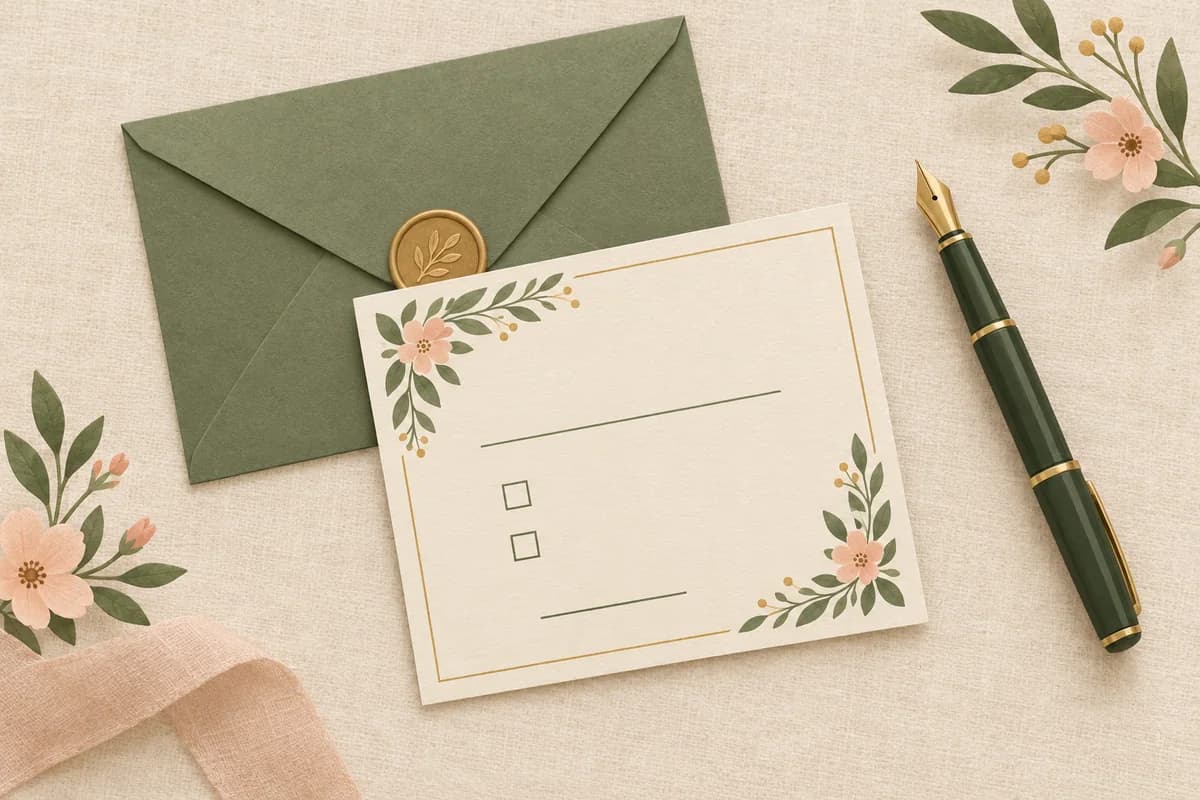
Digital illustration. On a printed reply card, the first line is for your name, the boxes say whether you will attend, and the short line is for how many are coming.
- Name line (M____)
- Your title and name, plus a named guest if one is invited.
- Tick boxes
- Accepts or declines.
- Short line
- The number attending.
How do you RSVP?
To RSVP, tell the host yes or no, by their date, in the way the invitation asks. These six steps cover paper cards, links and texts alike.
- Check who is invited. Read the envelope or the invitation's greeting. The names there are the people included.
- Find the date and the method. Look for "RSVP by," "kindly reply by" or a link, a phone number or an email address.
- Respond promptly. How long to reply? As soon as you know. A day to check your calendar is fine; weeks are not.
- Give the details the host asked for. That usually means your name and the number attending, plus meal choices or allergies if there's a place for them.
- Match the formality. A printed card goes back by mail in its envelope; an emailed invitation can get an emailed reply (Emily Post Institute).
- Keep your word. If something changes, tell the host right away.
A decline doesn't need a reason. A short, warm line is enough.
Reading one invitation, start to finish
Fictional example. Adapt the details for your event.
The invitation, addressed to "Mr. and Mrs. Lee": Join us for Maya's 40th birthday dinner, Saturday, March 14, at 7 pm. Kindly reply by March 1 at the link below. Let us know about any allergies.
Who is invited? The envelope names two adults, so the Lees reply for two and their kids stay home with a sitter.
By when? "Kindly reply by March 1," so they answer the week it arrives.
How? "At the link below," so they use the link, not a text to Maya.
What details? "Any allergies," so they add that one guest avoids shellfish.
Their whole RSVP, sent through the link: "Yes, attending, party of 2. One of us avoids shellfish. Thank you, and happy birthday, Maya!"
What should an RSVP reply say?
The right reply is short: your answer, who is coming, and any detail the host asked for. Here are 12 RSVP reply examples to copy; change the names and dates to yours.

Digital illustration. Text, card or email: match the reply method the invitation asks for, and keep the message short.
- Text
- One or two lines.
- Card
- Your name and the number attending.
- A short note with any details the host asked for.
- By text: Hi Priya! Count me in for Saturday. I'll bring the lemon bars I promised.
- By email: Hi Tom and Lena, thank you for the invitation. Sam and I will both be at the anniversary dinner on May 9 and can't wait to celebrate with you.
- On a reply card: M: Mr. Daniel Okafor and Ms. Jo Park · accepts · number attending: 2.
- By text: Hi Priya, thank you so much for thinking of me. I'm away that weekend, so I'll have to miss it. Have a wonderful party!
- By email: Dear Mrs. Alvarez, thank you for inviting us to Sofia's graduation party. We're sorry we can't be there on June 14, and we're sending Sofia our warmest congratulations.
- On a reply card: M: Ms. Rachel Kim · declines. A short "Sending love to you both" in the margin is a kind touch.
- By text: Hi Marcus, I'd love to come. I'm waiting on my work schedule and will give you a firm answer by Wednesday. Is that OK?
If the host can't wait, decline now, since a clear no is easier to plan around than a long maybe.
- Plus-one, by email: Hi Jess, yes, I'll be there! Thank you for including a guest. I'll be bringing my partner, Alex Moreno.
- With kids, by text: Hi Nora, we'd love to come to Leo's birthday. That's two of us: me and Mia, age 6. Should I stay for the party or drop her off?
- Dietary note, on a link form: Yes, attending, party of 2. Note: my husband has a tree-nut allergy, so he'll skip anything with nuts.
- A late reply, by text: Hi Kim, I'm so sorry, I missed your RSVP date. I'd still love to come to the shower if there's room. If you've already finalized numbers, I completely understand.
- Changing yes to no, by phone or text: Hi Chris, I'm so sorry, but I have to change my RSVP to a no for Friday. My flight home was moved. I hope it's a great night, and I'd love to catch up soon.
Can you bring a plus-one or your kids?
You can bring a plus-one or your children only if the invitation includes them. The envelope or the greeting tells you exactly who is invited (Emily Post Institute).
- "and Guest" means one companion. If the invitation has only your name, it's for you alone.
- Children are invited when they're named, such as "The Reyes Family" or each child's name. An envelope addressed to two adults doesn't include their kids (Emily Post Institute).
- Don't ask to add people to a wedding or a seated dinner. For a casual party you may ask once, and accept the answer gracefully.
- Count carefully. "Number attending: 3" should mean three people the invitation actually names.
What if you missed the RSVP date?
If you missed the RSVP date, reply as soon as you notice, apologize briefly and let the host decide. Don't just show up: the count may already be with the caterer.
- Reach the host directly by text, phone or email rather than through a group chat.
- Make it easy to say no: "If it's too late, I completely understand."
- If the invitation link says replies are closed, contact the host instead of trying again.
- If you can't come anyway, still say so. It answers the question the host is waiting on.
Is it rude not to RSVP, or to say yes and not go?
Yes, both are rude when you can avoid them. A missing reply leaves the host guessing, and a no-show after a yes can mean a paid-for seat and meal go unused.
The fix is simple. Reply when you get the invitation, and if you can no longer attend, tell the host as soon as you know (MIT International Students Office).
True emergencies happen, and a quick message on the day is still far better than silence. If you never reply at all, expect the host to plan as if you're not coming.
Why do Americans say RSVP?
Americans say RSVP because English borrowed the French phrase when French was the language of polite society. In the 1800s, formal French hosts needed accurate guest lists, and English speakers kept the original wording because it sounded elegant (Mental Floss).
The abbreviation has been recorded in English since the late 1890s (Dictionary.com). Today it's ordinary American English, used on everything from wedding cards to office lunches.
The "Please RSVP" redundancy is real: because "please" is already inside the letters, it says "please" twice. Almost everyone writes it anyway, and every guest understands it. If you want a cleaner line, "RSVP by June 1" or "Please reply by June 1" does the same job.
How should hosts ask for RSVPs?
Ask clearly, once, with three things together: the date, the method and what you need to know. Guests reply faster when they don't have to search for how.
Six RSVP lines you can use or adapt:
- Please RSVP by Saturday, May 2, using the link below.
- Kindly reply by June 1 so we can confirm numbers with the caterer.
- Let us know by Friday if you can make it. A quick text to Jordan is perfect.
- RSVP by March 10, and tell us the name of your guest if you're bringing one.
- Please reply by April 3 with each guest's meal choice and any allergies.
- Regrets only, to Sam by June 20. We'll assume we'll see you there!
Choosing the date itself takes some planning: work backward from your caterer's or venue's headcount deadline. The RSVP deadline guide and the birthday invitation wording guide, linked at the end of this guide, walk through it with examples.
Then follow up once with anyone who hasn't answered. A short, friendly reminder a few days before your date usually lands the last replies. Keep your tone light, and make "no" as easy to send as "yes."
How do RSVPs work on an InviteBird invitation?
On an InviteBird invitation, guests reply right from the invitation link, with no account to create and no app to install. Here is exactly what happens, from both sides.
- They open the link from the email or text you sent. Invitations go by email, or by text to US and Canada numbers after a one-time opt-in.
- They enter their name and an email or phone number, then choose Yes, I'm in, Maybe or Sorry, can't.
- If you allow extra guests, a "yes" asks how many are coming. You set the limit, from 1 to 10 extra per reply, and companions' names are optional.
- If you've set up a menu, they pick a meal and can add allergy notes.
- If plans change, they can update their answer from Manage your RSVP while your event is live.
- Replies sort themselves into going, maybe and can't make it, with party sizes, plus-one names and meal choices on your guest list. The online RSVP tracking page, linked at the end of this guide, shows the full view.
- Got an answer in person or by phone? Record it on the guest's row yourself, so your count stays in one place.
- An RSVP by · [date] line appears on the invitation when you set one. You can also choose to close new replies automatically after that day; guests who already replied can still edit their answer.
- RSVP reminders go by email only, and only to guests who haven't replied. Choose 7, 3 or 1 day before the event, or a custom number of days. Nest and Hatch include up to 3 automatic reminders per event (or unlimited for a one-time $2.99), and Flight and larger plans include unlimited reminders.
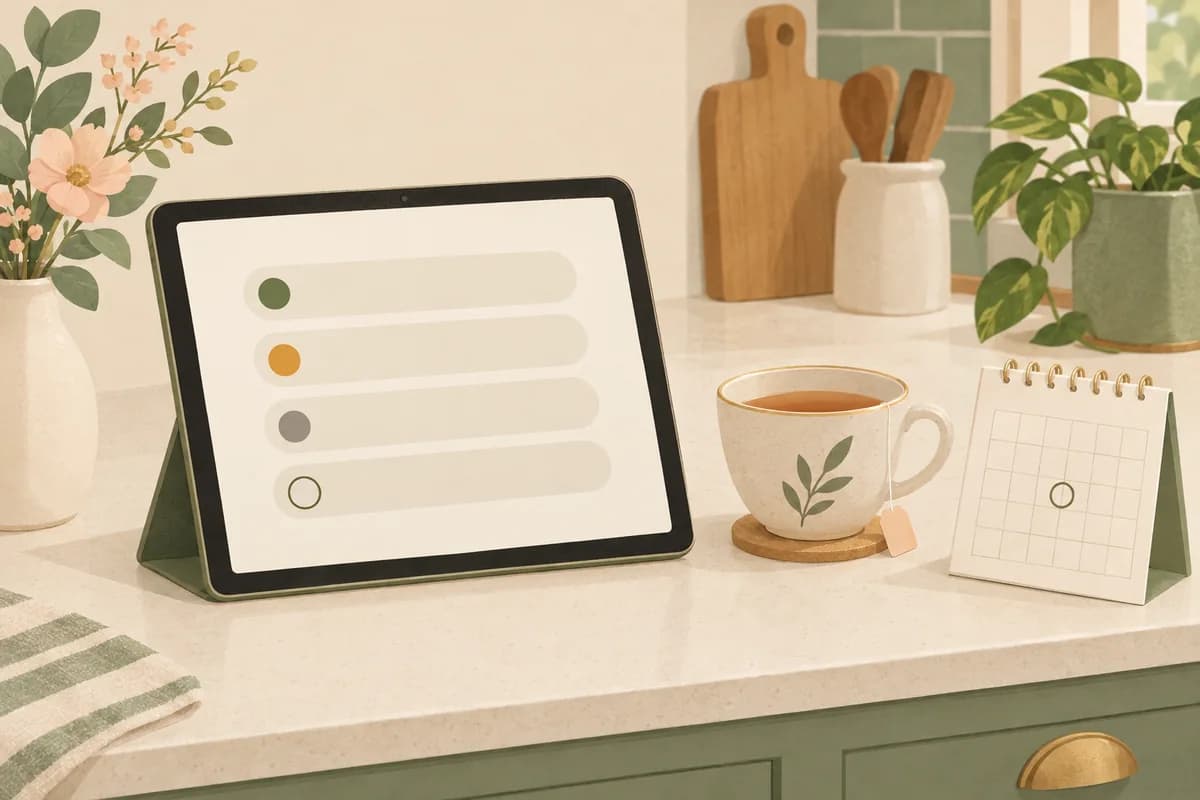
Digital illustration. Replies sorted at a glance: going, maybe, can't make it, and still waiting to hear.
- Green
- Going.
- Amber
- Maybe.
- Gray
- Can't make it.
- Empty
- No reply yet.
Hosting? Pick an invitation design and collect RSVPs right in the invitation: design free, pay when you send, from $9.99 for up to 25 people, counting plus-ones. The step-by-step help article and the designs are linked at the end of this guide.
Common questions about RSVP
What does RSVP stand for in English?
RSVP stands for the French répondez s'il vous plaît. In English, that means "please respond" or, more literally, "respond if you please."
What is the full name for RSVP?
The full phrase is répondez s'il vous plaît. English speakers almost always use the four letters instead of the full French.
Does RSVP mean reply?
Yes. RSVP is a request to reply, and an RSVP is also the reply itself, whether it's a yes or a no.
Do you respond to an RSVP if you are not attending?
Yes. Unless the invitation says "regrets only," the host needs your "no" as much as anyone's "yes." A short, polite note is enough, and you don't owe a reason (Emily Post Institute).
Is it rude to RSVP and not go?
It is, if you don't tell the host. If your plans change, let them know as soon as you can so they can adjust the count. A sudden illness or emergency is understood; just send a message.
What are you supposed to say when you RSVP?
Say yes or no, who is coming and any detail the host asked for, like a meal choice. "Yes, two of us will be there, thank you for having us!" is a complete RSVP. The 12 reply examples above cover more cases.
What does the M mean on an RSVP card?
The "M" starts the name line on a printed reply card. It prompts you to write your title and name, such as Mr., Mrs., Ms. or Mx., followed by the name of your guest if one is invited (Emily Post Institute).
Put the plan into practice
- Browse invitation designs
Pick a design and collect replies right in the invitation.
- Birthday invitations
Birthday designs with online RSVPs built in.
- Collect RSVPs online
Guests reply from the invitation link with no account or app; you see going, maybe and can't make it in one list. Design free, pay when you send, from $9.99.
- Send RSVP reminders
Email reminders that reach only the guests who have not replied yet.
- How RSVPs work in InviteBird
The step-by-step help article: what guests see and what you see.
- How to choose an RSVP deadline
Work backward from your caterer's or venue's headcount date, with an example.
- Birthday invitation wording with RSVP lines
Full invitation wording you can adapt.
- Digital invitations or a group chat?
When a proper invitation beats a message thread for collecting replies.
Sources and further reading
- Dictionary.com: RSVP
Origin (French répondez s'il vous plaît, 'respond if you please'), first recorded 1895-1900, pronunciation and the forms RSVPed, RSVP'd and RSVPing. Opened October 15, 2026.
- Emily Post Institute: The Continuing Importance of the RSVP
Reply as soon as possible; an emailed invitation can get an emailed reply; a simple, polite note of regret needs no reason. Opened October 15, 2026.
- Emily Post Institute: How to Word a Wedding Response Card
The M line for your name and an invited guest's name, accept and regret lines, the reply-by date and meal choices. Opened October 15, 2026.
- Emily Post Institute: Be a Gracious Wedding Guest
The envelope shows who is invited, 'and Guest' means one companion, children only when named, and reply right away even if you cannot attend. Opened October 15, 2026.
- Emily Post Institute: How to Signal No Children at Your Wedding
How an invitation is addressed shows exactly who is invited; do not assume children are included. Opened October 15, 2026.
- MIT International Students Office: RSVP and the Etiquette of Responding to Invitations
RSVP as a noun and a verb, what regrets only means, and telling the host when plans change. Opened October 15, 2026.
- Mental Floss: What Does RSVP Actually Stand For?
Logan DeLoye, January 15, 2026: formal French hosts of the 1800s and why English kept the French wording. Opened October 15, 2026.
Ready to put this into practice?
Pick a design, add your details and send it with InviteBird.Browse invitation designsKeep planning
- RSVP deadline: how to choose the right date12 min read

- Invitation text message: examples and etiquette12 min read
- Birthday invitation wording for every age14 min read