Friendsgiving ideas: menu, decor and games
Friendsgiving ideas work best when you pick one format first: you cook the whole meal, everyone brings a dish, or you make the main and friends cover the rest. Then share a bring list with the invitation, set a reply date, and add a simple table, a warm gratitude moment and a game or two.
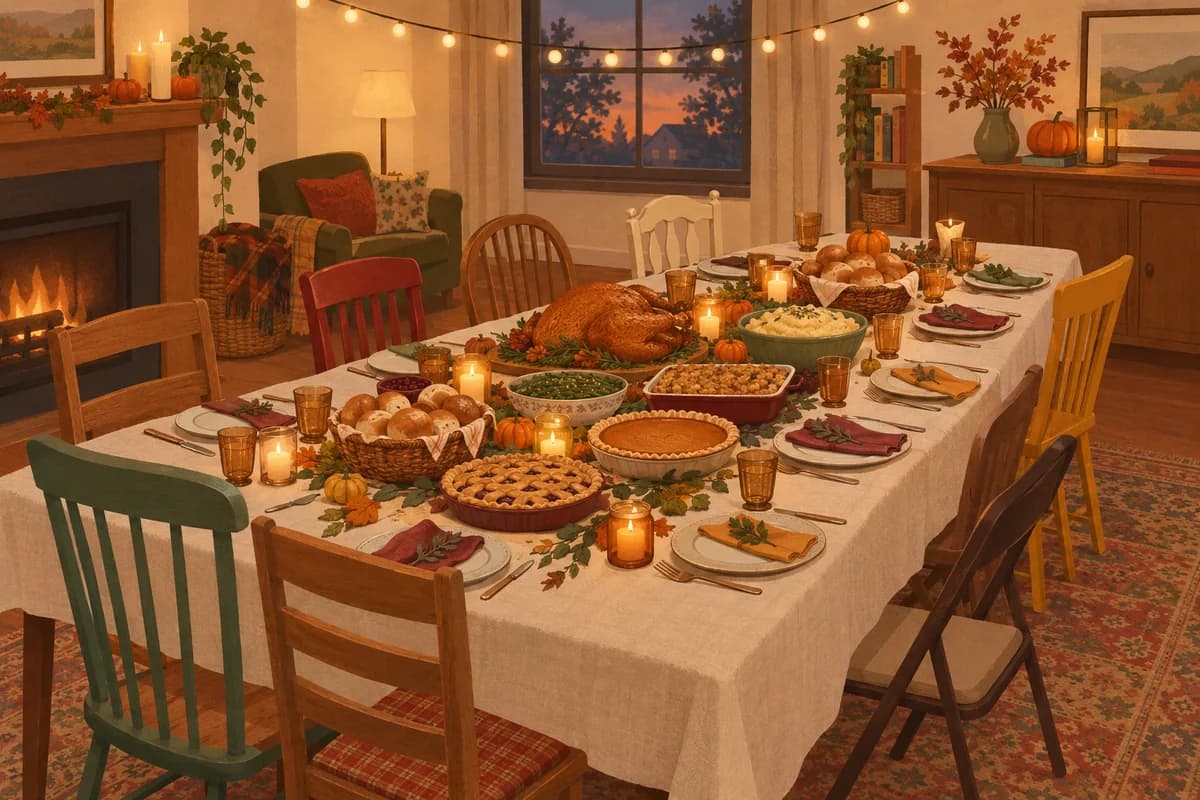
Digital illustration. At Friendsgiving the chairs, the bowls and the dishes often come from different homes, and that is part of the fun.
- Shared table
- One long table, chairs borrowed from friends, the host's main dish in the middle and the sides, rolls and pies that friends brought around it.
- Pick one format first: you cook everything, everyone brings a dish, or you make the main and friends cover the rest.
- Share the bring list with the invitation, so each friend claims a dish when they reply and the table comes out balanced.
- Set the reply date about a week before the dinner, so there is time to fill gaps and shop for anything still open.
What are some good ideas for Friendsgiving?
Start with these twelve ideas, then use the sections below for the menu, the table, the games and a countdown. Pick two or three that suit your group and your space.
- Make the turkey or main dish yourself, and let friends sign up for sides, desserts and drinks.
- Share one bring list, so the table gets a balance of dishes rather than four bags of chips.
- Add a vegetarian main and one gluten-free dessert, so every guest has a full plate.
- Try a global menu where each friend brings a dish from a family recipe or a favorite trip.
- Roll kraft paper over the table and set out markers for doodles and thank-you notes.
- Go around the table and have each person say one thing they appreciate about the friend to their left.
- Hold a pie bake-off with paper ballots and a silly prize.
- Run a small gift swap with a low price limit after dessert.
- Play a round of trivia or sketch-and-guess while the turkey rests.
- Set up a cider and hot chocolate bar instead of a full bar.
- Move dessert outside to a fire pit, or end with a movie on a sheet in the yard.
- Send everyone home with a to-go box of leftovers.
What is Friendsgiving, and when do people have it?
Friendsgiving is a Thanksgiving-style meal shared with friends instead of family. Dictionary.com describes it as an informal feast held on or near Thanksgiving Day, often on another day close to the holiday, especially the day or night before.
In the US, Thanksgiving falls on the fourth Thursday of November. A weekend before the holiday also works well, so nobody has to choose between friends and family travel.
Ask your friends for two or three possible dates before you send anything. The night that suits most people is the right night.
Which Friendsgiving format fits your group?
Choose the format before the menu, because it decides what you cook, what friends bring and what you spend. A potluck, or a hybrid where the host makes the main dish, spreads the work most evenly.
| Format | The host provides | Guests bring | Cost and effort for the host |
|---|---|---|---|
| Host cooks everything | The whole meal, drinks and the table | Themselves, maybe a bottle or flowers | Highest cost and most cooking; best for a small group or a host who loves to cook |
| Full potluck | The space, plates and a few drinks | Every dish, from the main to dessert | Lowest cost; needs a clear bring list so the courses balance |
| Hybrid: host makes the main | The turkey or main dish, gravy and the table | Sides, desserts, drinks and supplies | Medium cost; a fair way to share the work |
| Restaurant or takeout | A booking, or the order and the space | Their share of the bill, or a dessert | Little cooking; book the table or the order well ahead |
If you are new to hosting, start with the hybrid. You control the centerpiece dish and the timing, and your friends make the meal feel shared.
How do you split a Friendsgiving potluck?
Split a Friendsgiving potluck with one shared bring list. List every dish, drink and supply the table needs, with how many of each, and let friends claim items as they reply.
- Decide what you are making yourself. In a hybrid, that is the main dish and the gravy.
- List the rest by course: appetizers, sides, desserts, drinks and supplies.
- Plan about two items per guest: one dish, plus a drink or a supply.
- Put the must-haves first, such as the stuffing, the potatoes and the pie, so they are claimed early.
- Add a row for friends who do not cook, such as ice, rolls, chairs or to-go containers.
- A few days before the dinner, check what is still open and buy it yourself or ask a friend directly.
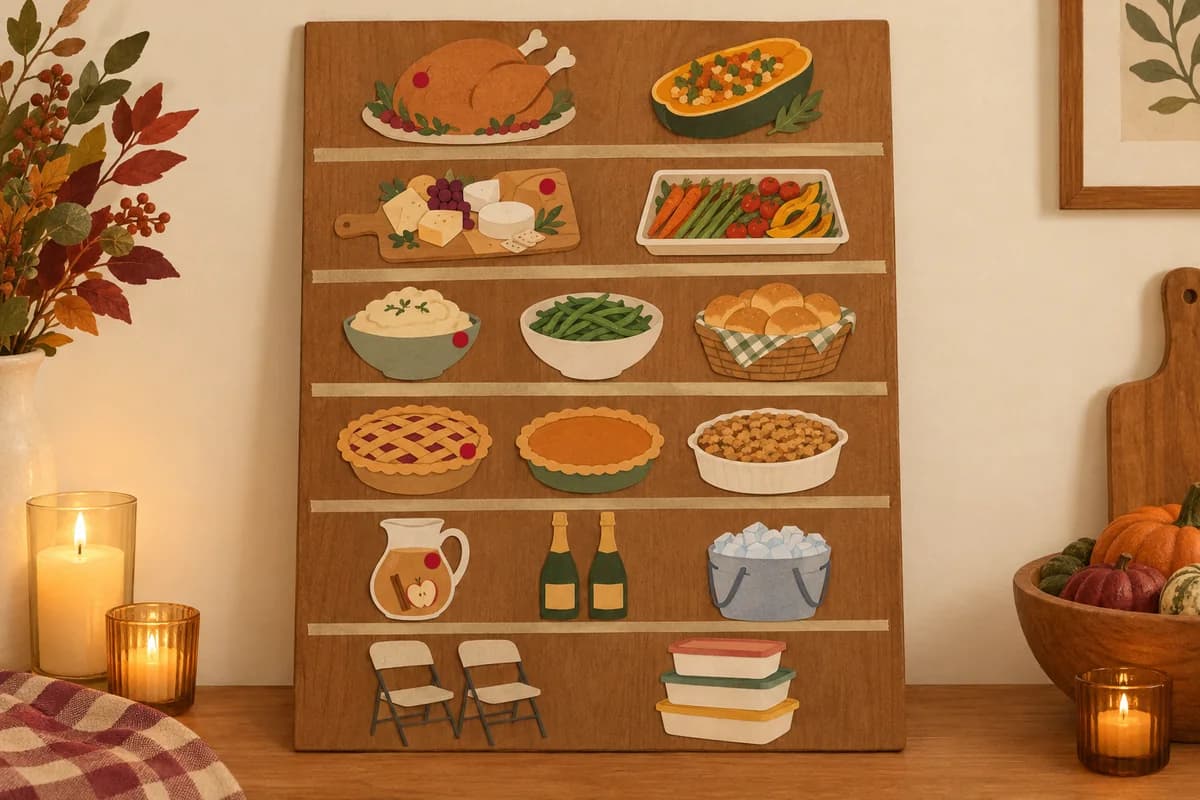
Digital illustration. Sort the bring list into rows by course, and mark each item as soon as someone claims it.
- Six rows
- One row each for mains, appetizers, sides, desserts, drinks and supplies, from the turkey at the top to the folding chairs and containers at the bottom.
- Taken items
- Once an item is claimed it is marked as taken, so the next friend picks something still open.
A 12-person Friendsgiving bring list, filled in
Fictional example. Adapt the details for your event.
The plan: a hybrid Friendsgiving for 12 on the Saturday before Thanksgiving. Quinn, the host, roasts the turkey and makes the gravy; the other 11 friends fill the list.
Mains: roast turkey and gravy (Quinn) · a vegetarian main, such as stuffed squash (1).
Appetizers: a cheese and cracker board (1) · a vegetable tray with dip (1).
Sides: mashed potatoes, stuffing, green beans, mac and cheese, roasted root vegetables and cranberry sauce (1 each) · dinner rolls (2 packs).
Desserts: pumpkin pie (1) · apple crumble (1) · a gluten-free dessert (1).
Drinks: apple cider (2 jugs) · sparkling water (1 case) · bags of ice (2).
Supplies: folding chairs (4) · to-go containers (1 pack) · foil and trash bags (1 set).
How it fills: the list holds 25 things for 11 friends, a little over two each. The nine friends who cook each take one dish, and most add a second dish or a drink. The two who do not cook take the ice, the chairs, the containers and the foil.
Quinn sets a "Needed by" date three days before the dinner on every item. Quinn buys whatever is still open after that on the last shopping trip.
With InviteBird, the bring list rides along with your invitation. Each item gets a category and a number from 1 to 99. There are six ready categories (Mains, Appetizers, Sides, Desserts, Drinks and Supplies), and you can add your own.
Friends who reply yes see an optional step that asks if they want to bring something, and they claim an item in one tap. A fully claimed item shows as already covered, so nobody can grab the last pie twice. Guests do not see who is bringing what; you and your co-hosts do.
If a friend changes their reply to no, their claims go back on the list by themselves. You can download the list as a PDF for the day. If you would rather collect dishes on paper, the printable potluck sign-up sheet linked below has a blank sheet and a host checklist.
Which Friendsgiving themes and table ideas work?
A theme gives friends a hint for what to bring and what to wear, and it does not need to cost much. Pick one idea, carry it through the table and the playlist, and keep the rest simple.
- Harvest table: a linen runner, mini pumpkins, pinecones and candles in jars.
- Kraft paper tablecloth: brown paper over the table and a cup of markers at each end for doodles and thank-yous.
- Around-the-world potluck: each friend brings a dish from their family or a trip, with a card that names the place.
- Cozy night in: sweaters or pajamas, blankets on the sofa, and a movie after dessert.
- Fire pit Friendsgiving: dinner inside, then pie and cider outside by the fire.
- Brunch Friendsgiving: a turkey hash, waffles, a cider bar and an early finish.
- Candlelit dinner party: cloth napkins, low candles and one long table.
- Mismatched-plate table: everyone brings a plate, and the table looks better for it.
- Leftovers swap: a stack of to-go boxes and labels, so every guest leaves with a little of everything.
- Hot drinks bar: cider, hot chocolate and tea with cinnamon sticks and whipped cream.
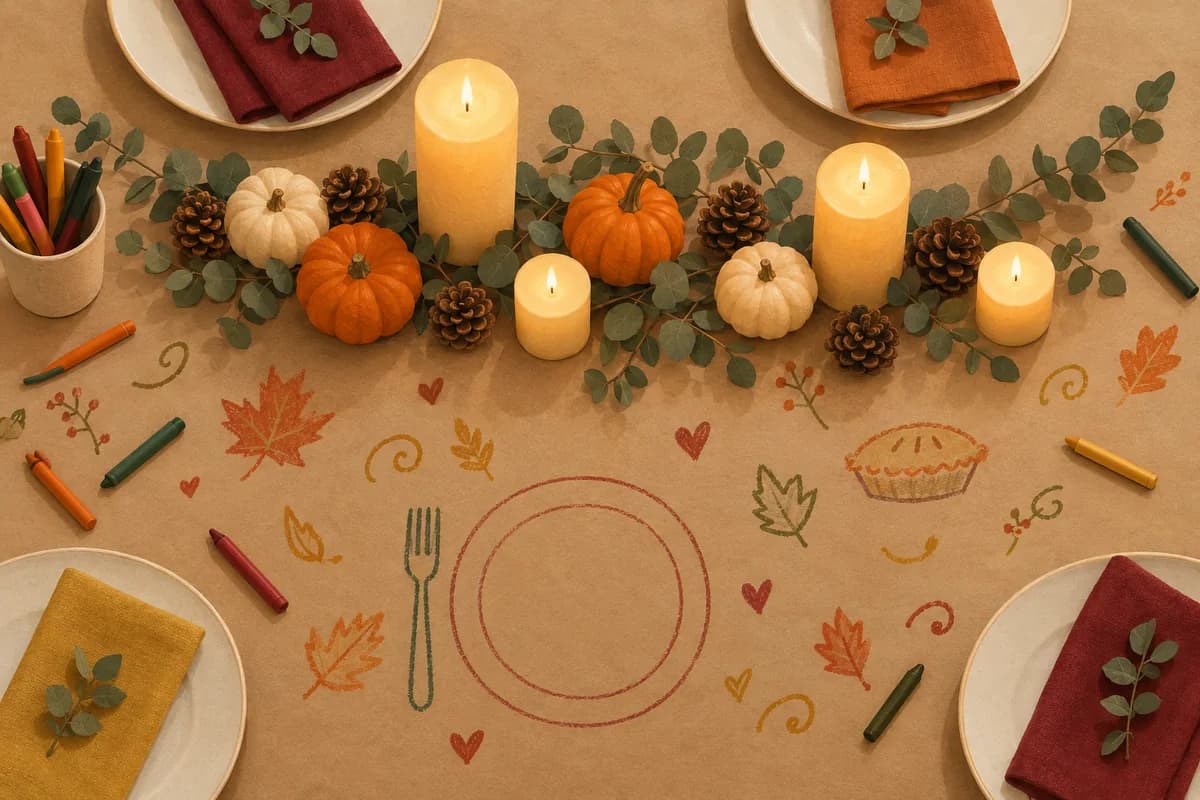
Digital illustration. A roll of kraft paper and a cup of markers make an easy tablecloth that guests can draw and write thanks on.
- Kraft paper table
- Roll brown paper over the table, set a cup of markers by each end, and invite guests to doodle or write what they are thankful for.
- Centerpiece
- Pillar candles, mini pumpkins and pinecones along a line of eucalyptus, plus a sprig on each napkin to match.
Keep centerpieces low, so friends can see each other across the table. Battery candles are a safer pick near coats, paper and markers.
What are some fun Friendsgiving activities?
Fun Friendsgiving activities fall into two groups: a gratitude moment at the table and a game or contest after the meal. One of each is plenty, and conversation will fill the rest.
How do you host Friendsgiving on a budget or in a small space?
Host Friendsgiving on a budget by making one dish yourself and sharing the rest. In a small space, serve from a counter so the table only holds plates and glasses.
- Make the main dish the one thing you spend on, and ask friends to cover sides, desserts and drinks.
- Choose a turkey breast, roast chicken or a big pot of chili instead of a whole bird for a small group.
- Ask friends to bring a drink to share instead of buying a full bar.
- Borrow chairs, plates and serving spoons from friends; add them to the bring list as supplies.
- Push the dining table and a folding table together under one long cloth.
- Use floor cushions, a bench or the sofa for extra seats, and eat buffet-style.
- Set coats, bags and extra drinks in the bedroom or on the balcony to free up the main room.
- Make dessert a pie potluck, since pies travel well and need no oven space.
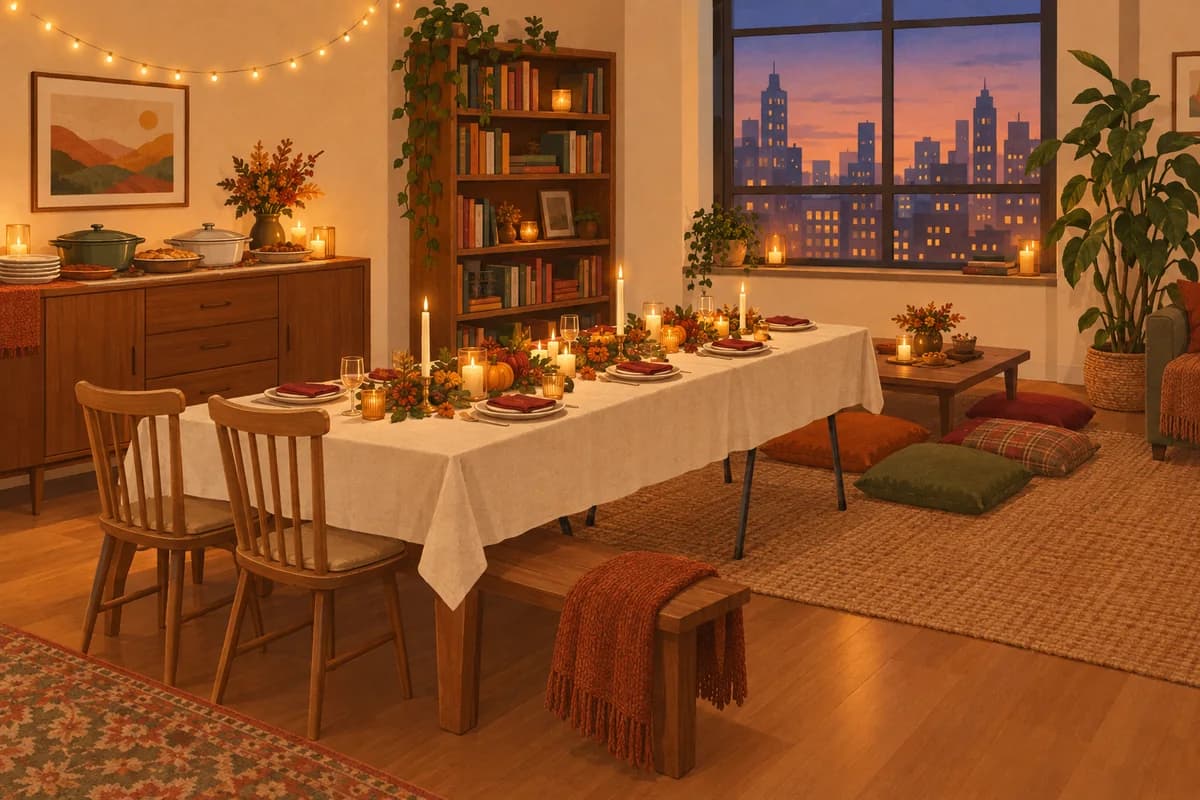
Digital illustration. Push two tables together under one cloth and use a shelf or counter as the buffet to seat more friends in a small room.
- One long table
- A folding table added to the end of the dining table, both under one cloth.
- Extra seats
- A bench, floor cushions and a low table at the end for friends who like the floor.
- Buffet
- Food served from a counter, sideboard or shelf, so the table holds plates and glasses only.
Your Friendsgiving countdown
Plan Friendsgiving about three weeks ahead, and set the reply date about a week before the dinner. That week gives you time to fill gaps in the bring list and shop for the rest.
For that thank-you, the Thanksgiving wishes guide linked below has short lines for a Friendsgiving group chat.
How do you invite people to Friendsgiving?
A Friendsgiving invitation needs the date, the time, the address, the format and a reply date. If friends are bringing dishes, say so in the invitation and point them to the bring list.
| Style | Line |
|---|---|
| Hybrid potluck | "Friendsgiving at our place on Saturday, [date], at 4. We've got the turkey; you bring a side. Please reply by [date]." |
| Full potluck | "Come hungry and bring a dish to share. Claim something on the list when you RSVP, so we don't end up with four pies." |
| Cozy night in | "Pajamas encouraged, appetites required. Friendsgiving starts at 5, and the movie starts after dessert." |
| Small space | "Our table is small, but there's always room for one more chair. Bring yours if you can." |
| Slow dinner | "Join us for a slow dinner, good friends and too much pie. Tell us about any allergies when you reply." |
With InviteBird, you can send your invitation by email, by text in the US and Canada, or as a link for the group chat. Email reminders skip anyone who already replied. The bring list is part of the RSVP: friends answer first, and those who say yes can then claim a dish.
A 12-person Friendsgiving fits the Nest plan, which covers up to 25 guests. Design free, pay when you send — from $9.99. For friends who are away for the holiday, an animated Thanksgiving card costs $4.99 with no subscription.
Common questions about Friendsgiving
What day do people usually do Friendsgiving?
Usually on a day near Thanksgiving, which falls on the fourth Thursday of November in the US. Dictionary.com notes it is often the day or night before; a weekend before the holiday also avoids travel days. Pick the date most of your friends can make.
What are the rules of Friendsgiving?
There are no official rules, only good manners. Reply by the date the host gives, bring what you signed up for, label dishes with common allergens, offer to help clean up, and take your containers home.
What should I bring to Friendsgiving?
Bring whatever you claimed on the host's list. If there is no list, ask the host. A side dish, a dessert, drinks or ice are safe choices, and a dish that needs no oven space makes the host's day easier.
Is Friendsgiving a potluck?
Often, but not always. Some hosts cook everything, some make the turkey and ask friends for the rest, and some groups book a restaurant. The invitation should say which kind it is.
How do you plan a Friendsgiving at work?
Hold it at lunch in the office or a booked room, and run it as a potluck with a shared sign-up list. Keep the menu simple, label allergens on every dish, and add a gratitude board where people can post a note to a colleague.
Put the plan into practice
- Send an animated Thanksgiving card
For friends who cannot make it: $4.99, no subscription, sent now or scheduled for the day.
- Share a bring list with your invitation
An online potluck sign-up: guests claim a dish, drink or supply when they RSVP, and you see who is covering what. Design free, pay when you send — from $9.99.
- Set up a bring list
Step by step: categories, quantities, an optional 'Needed by' date, guest claims and the PDF download.
- Meal choices and dietary needs in the RSVP
If you cook the meal, guests can pick a dish and add allergy or dietary notes as they reply.
- Print a potluck sign-up sheet
A blank sheet, a filled-in sample and a host checklist, if you would rather collect dishes on paper.
- Thanksgiving games for family and friends
Turkey bingo, trivia, charades and sketch-and-guess, with a plan for fitting games around the meal.
- Thanksgiving wishes to send
Short lines for your Friendsgiving group chat the day after, and for friends who could not make it.
- How to choose an RSVP deadline
Work back from the day you need a final count to set the reply date.
- Browse the InviteBird Blog
More guides for planning parties, dinners and holiday get-togethers.
Sources and further reading
- Dictionary.com: Friendsgiving
Dictionary.com entry (no page date shown). Defines Friendsgiving as an informal gathering of friends to celebrate Thanksgiving with a feast, on or near Thanksgiving Day, and notes it is often held on other days near the holiday, especially the day or night before. Opened October 16, 2026.
- USDA FSIS: Your Safe Thanksgiving Guide
USDA Food Safety and Inspection Service, last updated November 25, 2025. Cooked turkey must reach at least 165 °F; allow about 24 hours of fridge thawing for every four to five pounds; do not leave perishable food at room temperature for more than two hours (one hour above 90 °F); use or freeze leftovers within four days. Live page opened in a browser October 16, 2026.
- FDA: Food allergies, what you need to know
US Food and Drug Administration, content current as of August 16, 2024. Names the nine major food allergens: milk, eggs, fish, crustacean shellfish, tree nuts, peanuts, wheat, soybeans and sesame. Opened October 16, 2026.
Keep planning
- Potluck sign-up sheet: free printable12 min read
- 20 Thanksgiving games for family and friends23 min read
- Thanksgiving wishes: 108 messages to send18 min read