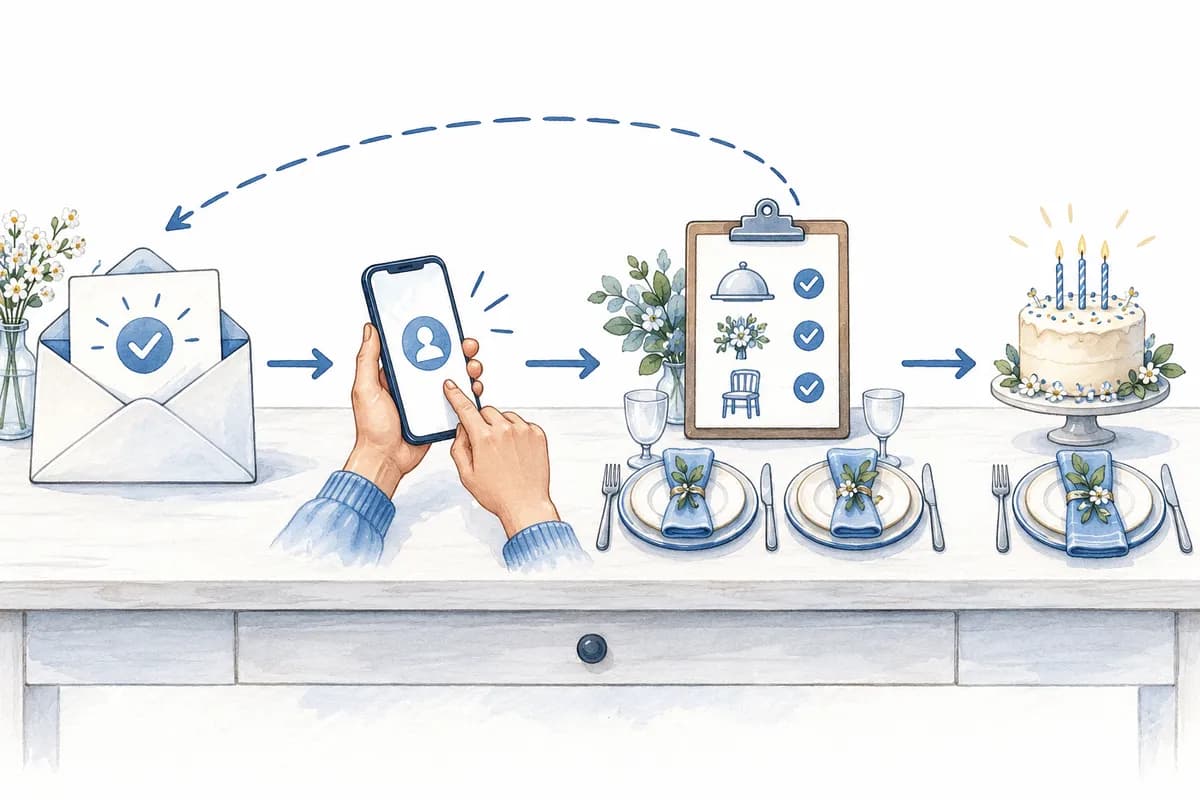
Potluck sign-up sheet: free printable
A potluck sign-up sheet is a shared list of the dishes and supplies a meal needs, with a space for who brings each one. Sort it by mains, sides, desserts, drinks and supplies, and ask each household for one dish. Print the free printable below, or let guests claim dishes online when they reply.
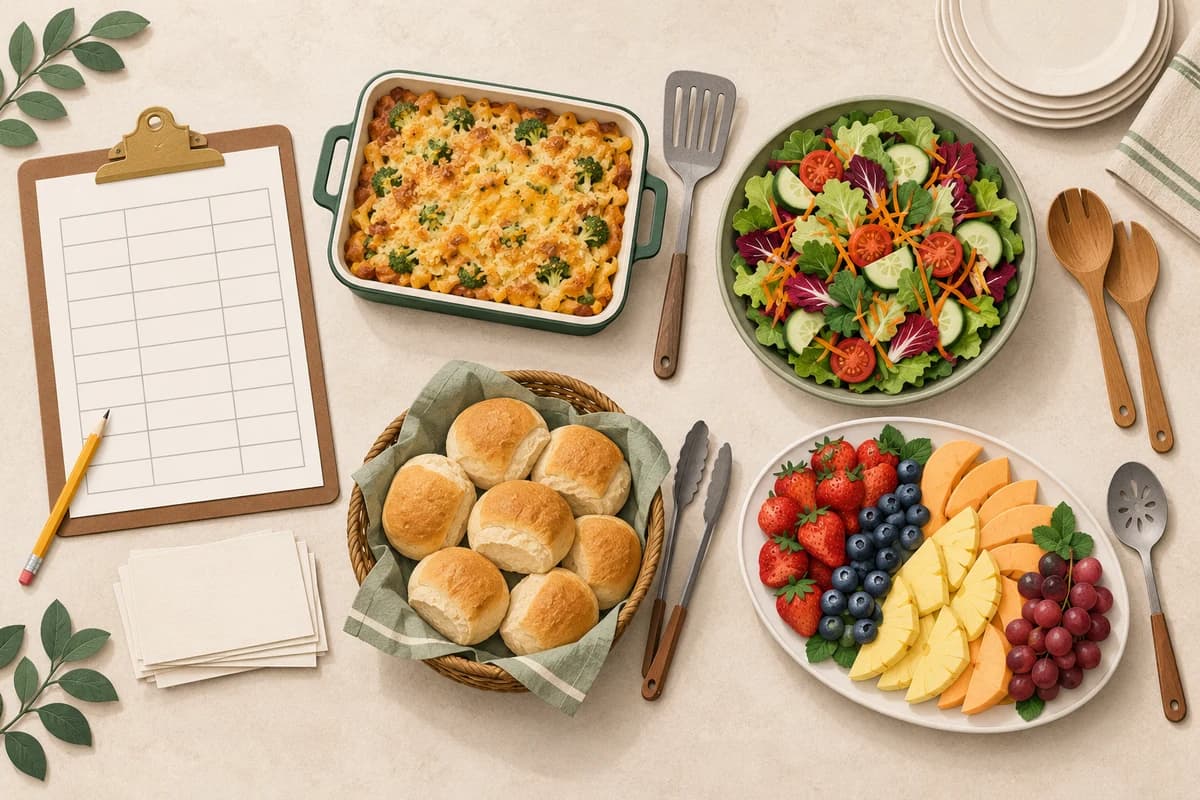
Digital illustration. Keep one coordinated dish list and confirm who will bring each dish and serving utensil.
- Choose a coordinator
- Name one person to keep the current dish list.
- List the dishes
- Write each dish and who brings it, then fill gaps and fix doubles.
- Confirm the handoff
- Confirm arrival time, serving utensils and setup needs with each cook.
- Sort the sheet by mains, sides, desserts, drinks and supplies, and write a number and a unit on every row.
- Our rule of thumb: ask each household for one dish that serves about 8 to 10 people, and let the host cover a main dish and the plates.
- Ask cooks to list ingredients and the major allergens on a card by each dish, and keep health details off the public sheet.
What is in the free printable potluck sign-up sheet?
The free printable pack has four pages: a blank sheet, a filled-in sample, a host handoff page and a checklist. It is plain HTML with no signup, and you print it from your browser.
| Page | Use it for |
|---|---|
| 1 · Blank sign-up sheet | List food and supplies, how much you need, who is bringing it and what is still open. Put this copy where guests can see it. |
| 2 · Filled-in sample | See how the columns work, including how to fix a row when someone cancels. |
| 3 · Host handoff sheet | Write down arrival times, serving spoons, equipment and fridge or oven needs. Keep it with the host. |
| 4 · Host checklist | Check the list before you invite, before you shop and on the day. |
Print in portrait on Letter or A4 at 100%, with browser headers and footers off. Write on the printed lines. The sheet does not save or share entries, so one person keeps it up to date.
How do you make a potluck sign-up sheet?
Pick one person to own the list, then write the details, the categories and the amounts before anyone signs up. These five steps work on paper, in a spreadsheet or online.
- Write the event, date, arrival time and place at the top. Add the list owner's name and a "last updated" date.
- List what the host is already making first, so guests can see what is covered.
- Add the open items under each category, with a number and a unit, such as "2 bags of ice."
- Let each guest choose one thing they can manage. Say that bringing something is optional, and that supplies and ice count too.
- When someone changes their plan, update the main copy, date it and fix any other copies before people shop.
What categories should a potluck sign-up sheet have?
Most potluck sheets use five categories: mains, sides, desserts, drinks and supplies. Add appetizers or breakfast items when the event calls for them.
| Category | Dishes and items to list | Tip for the host |
|---|---|---|
| Mains | Roast chicken, lasagna, chili, pulled pork, a vegetable curry | We suggest the host makes one main and asks guests for the rest. |
| Sides and salads | Green salad, roasted vegetables, mac and cheese, rice, bread rolls | We suggest more rows here than in any other category, because sides go with every main. |
| Desserts | Pie, brownies, cookies, a fruit tray | We suggest two or three for most groups. |
| Drinks | Lemonade, iced tea, sparkling water, coffee | Put ice on its own row with a number of bags. |
| Supplies | Plates, cups, napkins, serving spoons, foil, trash bags | A good choice for guests who cannot cook. |
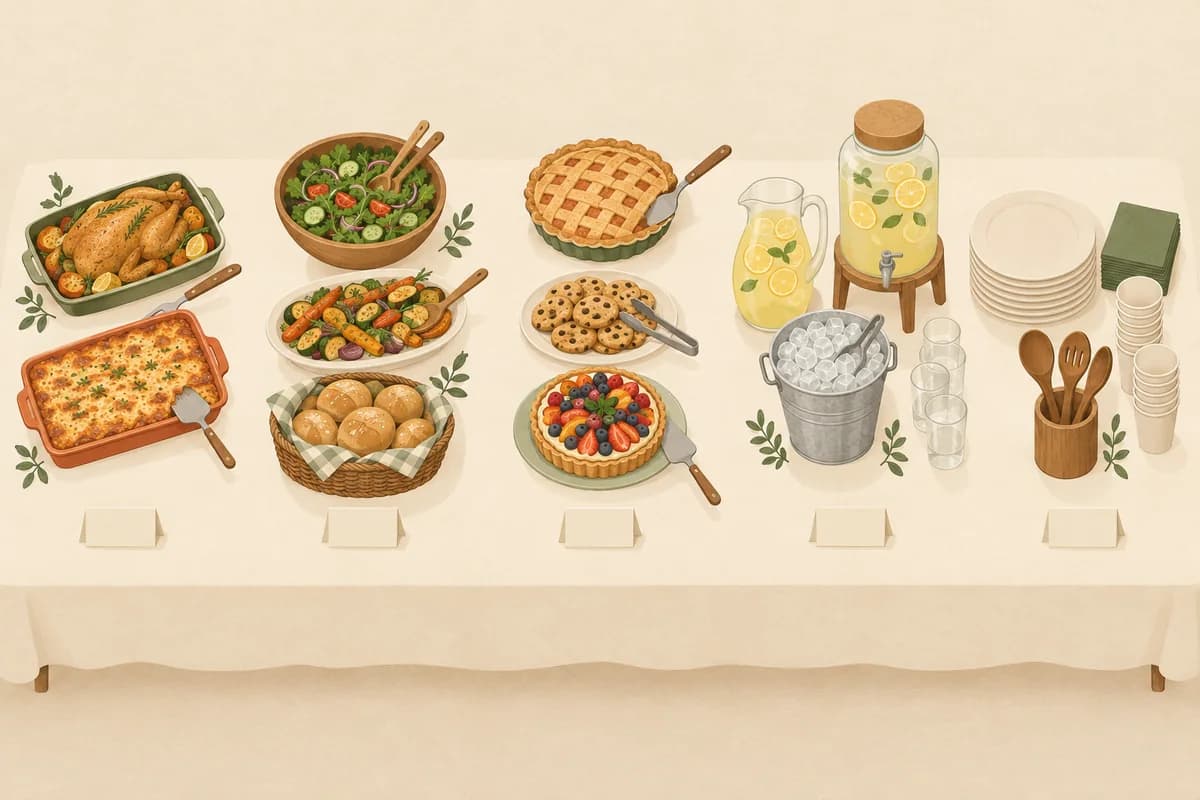
Digital illustration. Group the sign-up sheet the way the table will look: mains, sides, desserts, drinks and supplies.
- Mains
- Two or three main dishes, such as a roast or a lasagna, plus the host's main.
- Sides, desserts and drinks
- Salads, vegetables and bread; pies and cookies; a pitcher and ice.
- Supplies
- Plates, napkins, cups and one serving spoon per dish.
How many dishes should each guest bring?
Our rule of thumb: ask each household for one dish that serves about 8 to 10 people. Guests take a little of many dishes at a potluck, so one dish per household is usually enough.
The table below is our suggested starting split, not a rule. Adjust it for big eaters, kids and how long people will stay.
| Group size | Mains | Sides and salads | Desserts, drinks and supplies |
|---|---|---|---|
| 12 guests, about 6 households | Host's main + 1 | 2 | 1 dessert, 1 drinks and ice |
| 20 guests, about 10 households | Host's main + 2 | 4 | 2 desserts, 1 drinks and ice, 1 supplies |
| 40 guests, about 20 households | Host's main + 4 | 8 | 4 desserts, 2 drinks and ice, 2 supplies |
If a guest wants to bring two things, we suggest a second side before a second dessert. Check the sheet a week before, and ask kindly if anyone with an extra dessert could switch to a side.
What columns does a potluck sign-up sheet need?
Use five columns: category, item and amount, who is bringing it, what is still open, and a note for the host. That is enough to spot gaps and doubles at a glance.
| Column | What to write |
|---|---|
| Category | Mains, sides, desserts, drinks or supplies. |
| Item and amount | The item plus a unit: 4 bags of ice; 6 folding chairs; 2 pairs of serving tongs. |
| Bringing it | The guest's first name and how much they will bring, such as "Avery: 2 bags." |
| Still open | What is left, in the same unit. Write 0 when the row is full. |
| Note for the host | A short follow-up, such as "check freezer space." |
"Two bowls" means less than "two chairs." Ask a cook how big their dish is and whether a serving spoon comes with it. Write down what they tell you.
Check each row on its own; do not add bags, chairs and loaves into one total. A full supply row can sit next to an empty main-dish row.
How do you fix the sheet when someone cancels?
Take their name off every row they claimed, then work out what is still open in the same unit. This sample list shows the math on one evening.
| Item and amount | Who is bringing it | Still open | Host follow-up |
|---|---|---|---|
| Ice: 4 bags | Avery: 2 bags; Sam: 1 bag | 1 bag | Check cooler space. |
| Folding chairs: 6 | Jo: 4 chairs | 2 chairs | Check where they go. |
| Serving tongs: 2 pairs | Host: 1 pair; Lee: 1 pair | 0 pairs | Keep tongs with their dishes. |
| Green salad: 2 bowls | Casey: 1 bowl | 1 bowl | Ask about bowl size and ingredients. |
| Bread: 3 loaves | Morgan: 3 loaves | 0 loaves | Morgan brings the ingredient card. |
Sam cancels the day before
Fictional example. Adapt the details for your event.
Before: 4 bags of ice needed − 3 bags claimed = 1 bag open.
Sam drops out, so Avery's 2 bags are the only claim: 4 − 2 = 2 bags open.
The host asks Lee, who agrees to bring 2 bags, and writes "Lee: 2 bags" on the row: 0 open.
Date the fixed sheet and tell helpers which copy is current.
The other rows check the same way: 6 − 4 = 2 chairs; 2 − 2 = 0 pairs of tongs; 2 − 1 = 1 salad bowl; 3 − 3 = 0 loaves.
What should you agree on before the food arrives?
Agree on the arrival time, the serving spoon and any fridge or oven needs with each cook. A name on the sheet is not yet a plan for getting the dish onto the table.
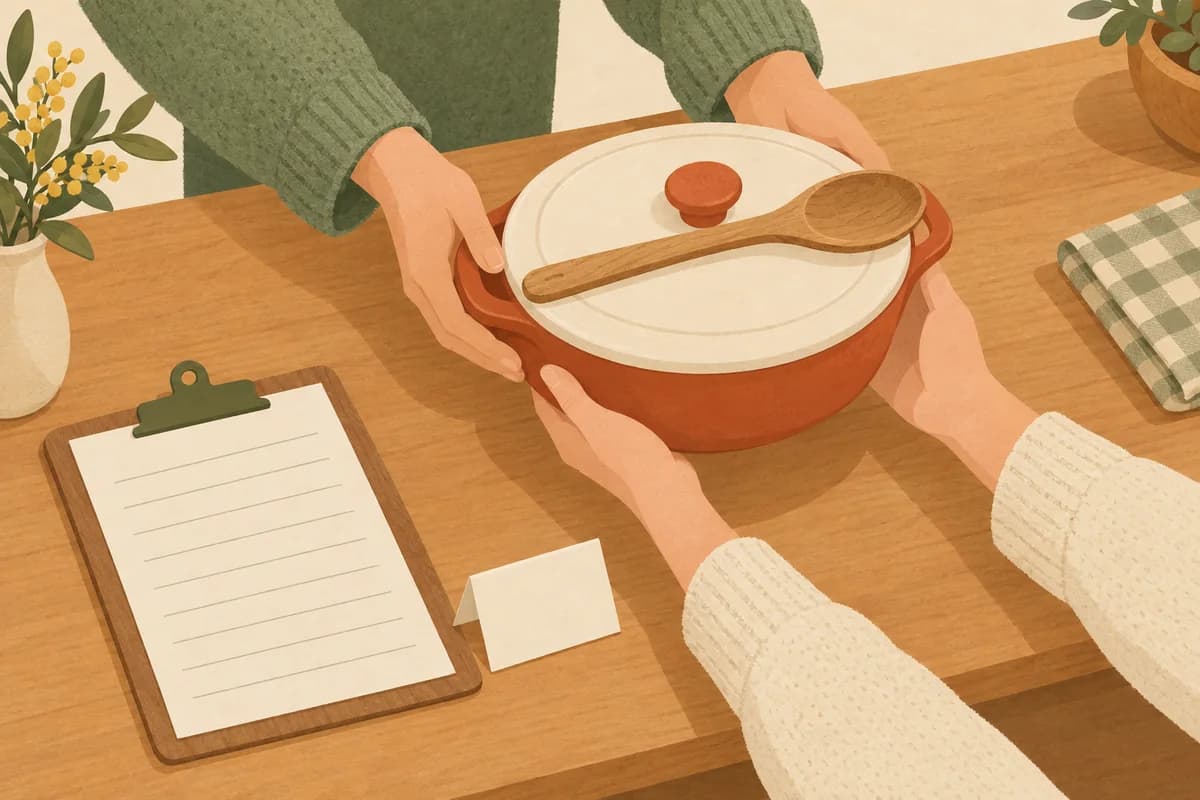
Digital illustration. Agree on arrival time, serving utensils and the dish's written details before the guest sets off.
- Arrival
- Confirm when the dish or equipment should arrive and who receives it.
- Serving
- Agree who brings the serving utensil and any equipment needed.
- Food details
- Ask for ingredient information and talk about handling needs; a label is not an allergy-safety promise.
If the kitchen cannot take a dish that needs an oven, agree on a different dish before the day. Do not leave a helper to work it out at the door.
How do you label allergens at a potluck?
Ask each cook to put a small card by their dish with the name, the main ingredients and a "Contains" line for major allergens. The FDA lists nine major food allergens: milk, eggs, fish, crustacean shellfish (such as shrimp, crab and lobster), tree nuts, peanuts, wheat, soybeans and sesame.
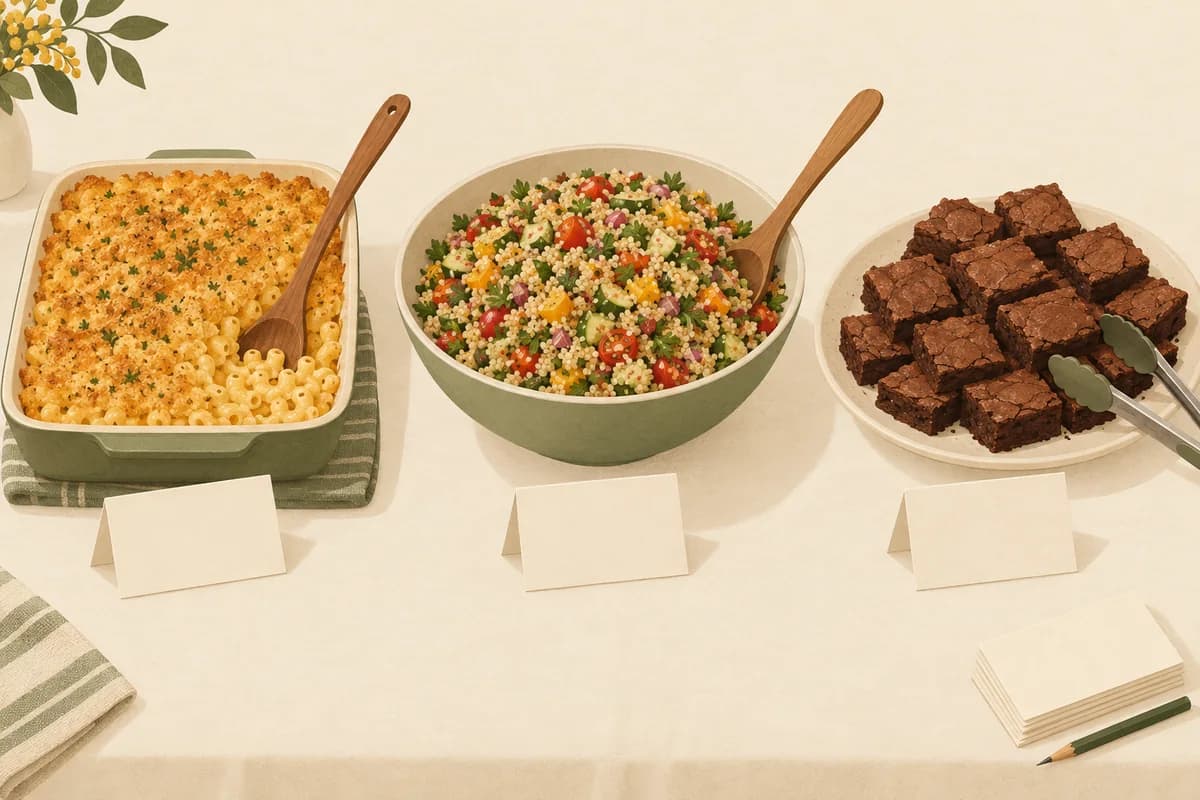
Digital illustration. A card by each dish lists its ingredients, and each dish keeps its own serving spoon or tongs.
- On each card
- The dish name, the cook's first name, the main ingredients and a Contains line for major allergens.
- At the table
- One serving spoon per dish, never shared between dishes.
A label helps guests choose, but it does not make a dish safe for someone with an allergy. FARE warns that even an invisible trace of food on a spoon can cause a reaction, that serving tongs and ladles get put back in the wrong dish, and that cooking does not remove the risk. Give every dish its own serving spoon, and keep a guest's own allergy talk private and direct.
The USDA says to hold hot food at 140 °F or warmer and cold food at 40 °F or colder, and not to leave perishable food out for more than 2 hours (1 hour above 90 °F). Agree with each cook ahead of time how their dish will stay hot or cold, such as a slow cooker or a bowl of ice.
How do you check the list on the day?
Give the helper at the door the current sheet and the handoff page, then check each dish against its row as it arrives. A name on the sheet and a dish on the table are not the same thing.
- Check the "last updated" date together so you both use the same copy.
- Tick each item and amount as it arrives, and note what actually came.
- Match each dish with its serving spoon and its fridge or oven spot.
- Check open rows before anyone goes to the store, so nobody buys a double.
- After the meal, return marked dishes and borrowed chairs to their owners.
Is there an app for potluck sign-up?
Yes: many invitation and sign-up tools have one, including InviteBird's What to Bring list. Use paper when one person can keep it current, and an online list when guests need to claim and change dishes themselves.
What to Bring has six ready categories: mains, appetizers, sides, desserts, drinks and supplies. Guests claim an item while they RSVP, see only what is still open, and can change or give back a claim later. You and your co-hosts see the names, can move claims around and can download the list as a PDF.
If you are cooking the meal yourself, Menu and Meals lets guests pick a dish as they RSVP and add allergy notes for you to review. Both are included on every plan: design free, pay when you send — from $9.99. The printable sheets stay separate and do not update your online list.
Common questions about potluck sign-up sheets
These quick answers cover what people ask most about running a potluck sign-up.
What is meant by potluck?
A potluck is a shared meal where each guest or household brings one dish for everyone. The host usually gives the place, the time and often the main dish.
What can I bring to a potluck?
Bring something that travels well and serves 8 to 10 people: a pasta bake, a big salad, a tray of roasted vegetables, cookies or a drink with ice. Check the sign-up sheet first and pick an open row. Bring your own serving spoon and an ingredient card.
How do you make a potluck sign-up sheet in Google Sheets or Excel?
Make five columns: category, item and amount, bringing it, still open and notes. Share the file with edit rights, and freeze the top row so the headings stay in view. Keep one owner who checks for doubles each week.
What should a potluck sign-up sheet for work or church include?
Add the room, the time the food should be set out and who cleans up. Include a supplies row for people who cannot cook, and keep the sheet in one shared spot. For Thanksgiving or Christmas potlucks, list the traditional dishes first, such as the turkey, stuffing or pies, so they get claimed early.
How far ahead should you share the sign-up sheet?
We suggest sharing it with the invitation, about two to three weeks before the event. Send one reminder a week before with the rows that are still open.
Put the plan into practice
- Browse holiday and seasonal invitations
Designs for Thanksgiving, Friendsgiving and holiday potlucks, with online replies built in.
- Open the free printable potluck pack
Four ungated pages you print from your browser: a blank sign-up sheet, a filled-in sample, a host handoff sheet and a final checklist.
- See the online What to Bring list
Guests claim dishes and supplies as they RSVP, and you see who is covering each item.
- Set up potluck sign-up in InviteBird
Step-by-step setup for categories, quantities, guest claims, host changes and the PDF download.
- Collect meal choices and allergy notes
If you serve the meal, guests pick a dish as they RSVP and can add allergy notes for you to review.
- Thanksgiving games for family and friends
Turkey bingo, trivia and a gratitude jar for the time before and after the meal.
- Write a Christmas potluck invitation
Wording that keeps the reply and the optional dish sign-up clear.
Sources and further reading
- FDA: Food Allergies — What You Need to Know
Food and Drug Administration, content current as of August 16, 2024. Lists the major food allergens (crustacean shellfish among them), sesame as the ninth under the FASTER Act from January 1, 2023, and the 'Contains' statement on labels. Opened October 15, 2026.
- FARE: Avoiding cross-contact
Food Allergy Research and Education. Explains cross-contact: a trace of food on a spoon can cause a reaction, serving ladles and tongs get put back with the wrong food, and cooking does not reduce the risk. No page date; opened October 15, 2026.
- USDA FSIS: Steps to keep food safe
USDA Food Safety and Inspection Service, last updated January 5, 2024. Serving: hold hot food at 140 °F or warmer and cold food at 40 °F or colder; perishable food out no more than 2 hours (1 hour above 90 °F). Opened in a browser October 15, 2026.
Ready to put this into practice?
Pick a design, add your details and send it with InviteBird.Browse holiday and seasonal invitationsKeep planning
- 20 Thanksgiving games for family and friends23 min read
- Christmas party invitation wording examples17 min read
- RSVP deadline: how to choose the right date12 min read