How to address wedding invitations: examples
Address wedding invitations with each guest's title and full name, spelled out, with no middle initials. Name everyone who is invited: write a married couple as "Mr. and Mrs. Rafael Castillo" or with both full names, list invited children below their parents, and name a plus-one when you know who it is.

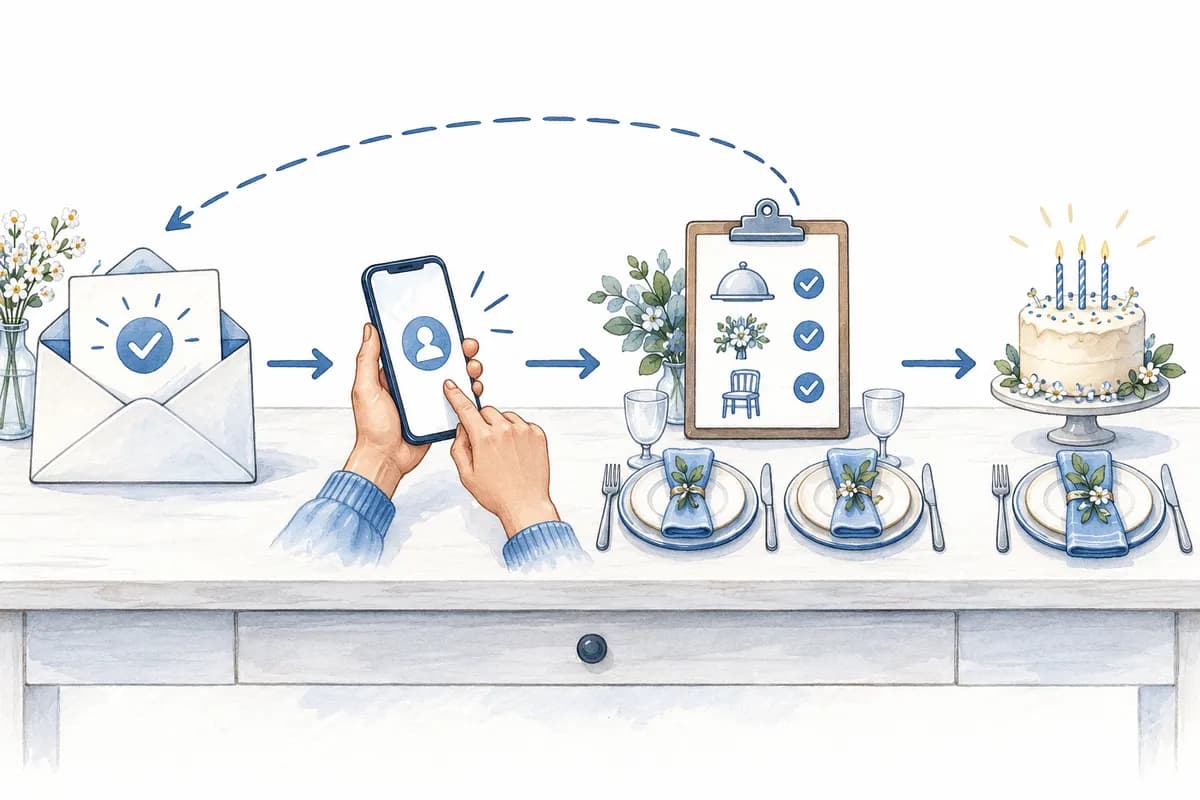
Digital illustration. A formal wedding invitation can travel in two envelopes: the outer one carries the mailing address, and the inner one names exactly who is invited.
- Outer envelope
- Titles, first and last names, and the full mailing address, for example Mr. and Mrs. Rafael Castillo.
- Inner envelope
- Titles and last names only, with invited children named below, for example Mr. and Mrs. Castillo, then Lucia and Mateo.
- Write each guest's title and full name, spell out every word except the titles, and name every person who is invited.
- Either partner can come first; a higher title such as Dr., a military rank or an elected office goes first.
- On an online invitation, the guest list does the envelope's job: one row per household, with everyone invited named on it.
What are the basic rules for addressing wedding invitations?
Use titles and full names, spell out every word except the titles, and name every person who is invited. The Emily Post Institute adds two more: no middle initials, and both members of a married couple are always named.
These are the forms for a formal wedding. For a casual one, first names without titles are fine, such as "Maria and Rafael Castillo".
How do you address a married couple?
Name both people. A couple who share a last name and use traditional titles can be "Mr. and Mrs." with the husband's full name. Otherwise, give each person a title and full name, joined by "and".
| Couple | Outer envelope | Inner envelope |
|---|---|---|
| Same last name, traditional | Mr. and Mrs. Rafael Castillo | Mr. and Mrs. Castillo |
| Same last name, she prefers Ms. | Ms. Maria Castillo and Mr. Rafael Castillo | Ms. Castillo and Mr. Castillo |
| Different last names | Ms. Priya Nair and Mr. Owen Hart | Ms. Nair and Mr. Hart |
| Two men, same last name | Mr. Felix Brooks and Mr. Eli Brooks | Mr. and Mr. Brooks, or the Messrs. Brooks if they prefer |
| Two women, same last name | Ms. Ana Ruiz and Ms. Kate Ruiz | Ms. and Ms. Ruiz |
| Any couple, casual wedding | Maria and Rafael Castillo | Maria and Rafael |
If the names don't fit on one line, put the second name on the next line, starting with "and".
Emily Post suggests asking two married men whether they prefer "Mr. and Mr." or "the Messrs." on the envelope. For two married women, "Ms. and Ms. Ruiz" follows the same pattern, so ask them too.
How do you address single guests and unmarried couples?
Give a single guest a title and full name. An unmarried couple who live together share one envelope, with both full names joined by "and", on one line if they fit.
| Guest | Outer envelope | Inner envelope |
|---|---|---|
| Single woman | Ms. Hannah Lee | Ms. Lee |
| Single man | Mr. James Ford | Mr. Ford |
| Guest who uses Mx. | Mx. Robin Sutton | Mx. Sutton |
| Widow, preference unknown | Mrs. Robert Hale | Mrs. Hale |
| Widow who uses her own first name | Mrs. Ellen Hale or Ms. Ellen Hale | Mrs. Hale or Ms. Hale |
| Divorced woman | Ms. Gail Dunn, or her birth name if she uses it | Ms. Dunn |
| Unmarried couple, same address | Ms. Nora Bell and Mr. Theo Grant | Ms. Bell and Mr. Grant |
Mx. is a title anyone can use, and it does not point to a gender. Miss is usually kept for girls under 18, and children listed under their parents need no title at all.
For a widow, Emily Post calls "Mrs." with her late husband's name the traditional choice when you don't know her preference. If you can, ask her.
If an unmarried couple live apart, none of the sources we opened gives one set form. Our suggestion: send each partner their own invitation, or send it to the guest you know and name the partner on the inner envelope.
How do you address a guest with a plus-one?
Name the companion if you know who it is. If you don't, Emily Post's advice is to keep "and Guest" off the outer envelope: address it to your guest alone and write "and Guest" on the inner envelope.
| Situation | Outer envelope | Inner envelope |
|---|---|---|
| Companion known, same address | Ms. Hannah Lee and Mr. Kofi Mensah | Ms. Lee and Mr. Mensah |
| Companion known, different address | Ms. Hannah Lee | Ms. Lee and Mr. Mensah |
| Companion unknown | Mr. James Ford | Mr. Ford and Guest |
| Companion unknown, one envelope only | Mr. James Ford | No inner envelope: add a short handwritten note saying he is welcome to bring a guest |
Not everyone agrees. Banter and Charm, a wedding stationer, simply writes "and guest" on the envelope. Emily Post calls that awkward and impersonal on the outer envelope and says to use the companion's name whenever you can.
When you learn the companion's name in time, Emily Post adds that you can send them their own invitation too.
How do you address a wedding invitation to a family?
Put the parents on the first line and each invited child below them, by first and last name, without a title. With an inner envelope, the children go there instead, under the parents' titles and last name.
| Household | Outer envelope | Inner envelope |
|---|---|---|
| Parents and young children | Mr. and Mrs. Rafael Castillo | Mr. and Mrs. Castillo, with Lucia Castillo and Mateo Castillo on the lines below |
| The same family, no inner envelope | Mr. and Mrs. Rafael Castillo, with Lucia Castillo and Mateo Castillo on the lines below | None |
| Everyone at the address, casual wedding | The Castillo Family | None |
| Grown child living at home, 18 or older | Ms. Emma Lin, on her own envelope | Ms. Lin |
| Adults only | Mr. and Mrs. Wei Lin | Mr. and Mrs. Lin, with no children listed |

Digital illustration. One envelope per household: the parents on the first line, and each invited child named below them.
- First line
- The parents, for example Mr. and Mrs. Rafael Castillo.
- Below
- Each invited child by first and last name, without a title, for example Lucia Castillo and Mateo Castillo.
Use "The Castillo Family" only if every person living there is invited. Paperlust, a stationery marketplace, calls this form fine for a casual wedding but not for a formal black-tie one. Grown children get their own invitation even when they live with their parents: Banter and Charm and Paperlust both give 18 as the age.
For an adults-only wedding, the names do the work. Emily Post explains that the inner envelope shows exactly who is invited and, by leaving names off, who is not.
If a reply comes back with children added, Emily Post's advice is to call right away and kindly. Explain that the invitation was for the guests named on it, and stay firm if they push.
How do you address doctors, military officers and other titles?
Put the higher title first. A doctor, a military officer or an elected official is listed before a spouse without that title, whatever their gender.
| Guest | Outer envelope | Inner envelope |
|---|---|---|
| One doctor, shared last name | Dr. Maria Castillo and Mr. Rafael Castillo, or Dr. Maria and Mr. Rafael Castillo | Dr. Castillo and Mr. Castillo |
| One doctor, different last names | Dr. Priya Nair and Mr. Owen Hart | Dr. Nair and Mr. Hart |
| Both doctors, shared last name | The Doctors Castillo, or Drs. Maria and Rafael Castillo | The Doctors Castillo |
| Both doctors, different last names | Dr. Priya Nair and Dr. Owen Hart | Dr. Nair and Dr. Hart |
| Military officer | Colonel Joan Whitaker and Mr. Neil Whitaker | Colonel Whitaker and Mr. Whitaker |
Emily Post uses the rank itself as the title, such as Colonel or General. Regular service members keep their titles in retirement, so ask a retired guest how they like to be addressed.
An elected official goes first in the same way: "The Honorable Ruth Adler and Mr. Paul Adler". Medical and academic doctors both use Dr.
What goes on the outer and inner envelopes?
The outer envelope carries the guests' titles, full names and mailing address. The inner envelope, if you use one, repeats only the titles and last names and lists any invited children, so it shows exactly who is invited.
| Detail | Outer envelope | Inner envelope |
|---|---|---|
| Its job | Gets the invitation to the right home | Shows exactly who is invited |
| Names | Titles, first and last names | Titles and last names, with invited children below |
| Address | The full mailing address | None |
| Sealed | Yes | No, it sits unsealed inside the outer one |
| Close family | Formal names | Familiar names are fine, such as Aunt Rosa and Uncle Tom |
| Required | Yes | No, many couples skip it |
Without an inner envelope, the outer one does both jobs. Write the adults on the first line, invited children below them, and a known companion's name beside your guest's. Paperlust calls the inner envelope an optional tradition; Emily Post still describes both.
What name goes on the return address?
Use the address where you want replies and gifts to arrive, usually the hosts' home. Emily Post notes that guests are likely to send both to the return address on the outer envelope, and that "RSVP" on its own points replies there too.
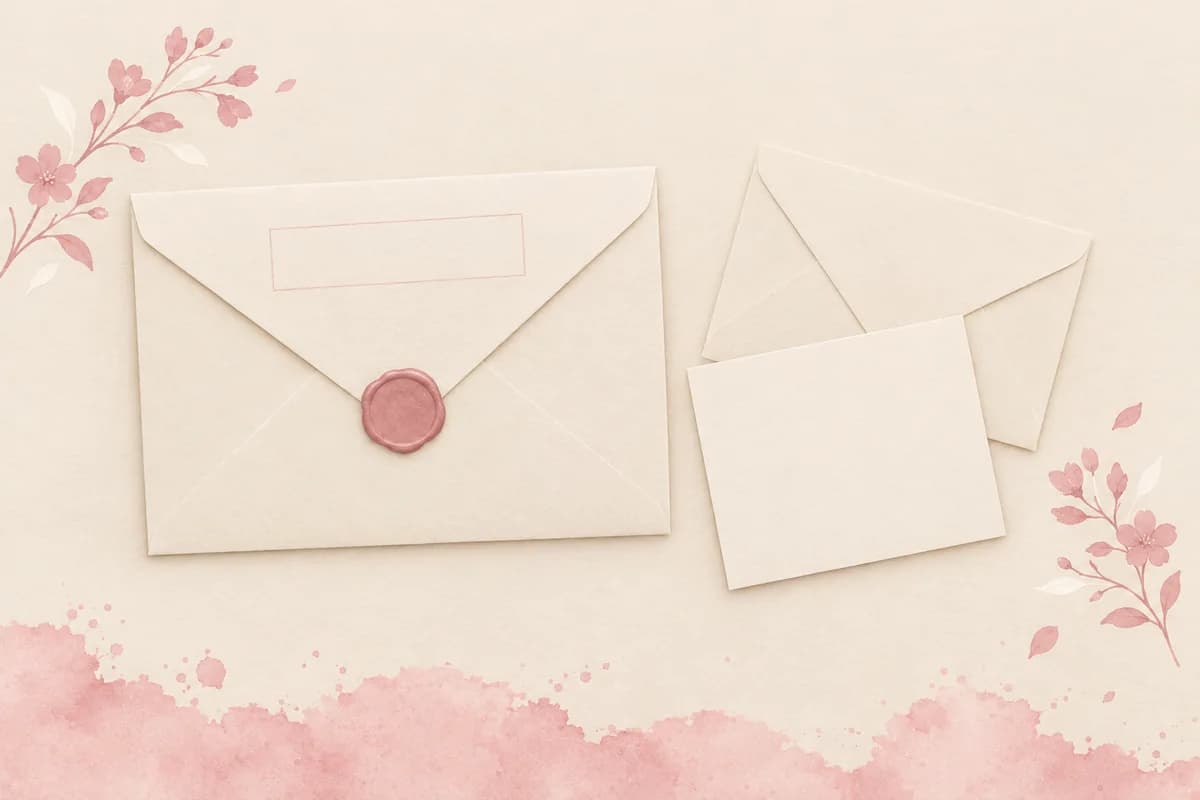
Digital illustration. The return address traditionally sits on the back flap, and guests send replies and gifts to it.
- Where
- Traditionally on the back flap; the top-left corner of the front is also accepted.
- Whose address
- The hosts' address, or wherever you want replies and gifts to arrive. Names are optional.
Names are optional. Banter and Charm says the hosts' names can be left off the return address. If you add a name, use the hosts', since the address is theirs.
Traditionally, the return address goes on the back flap. Paperlust notes that the top-left corner of the front is also widely accepted and easier for mail-sorting machines.
Emily Post says to address wedding envelopes by hand, with no labels, even for a long list. Stationers see it differently: Banter and Charm offers printed addressing, and Paperlust sells printed return address labels.
Where do etiquette sources disagree?
On eight points, respected sources give different answers. Pick one approach for each and use it on every envelope.
| Point | What the sources say | A simple choice |
|---|---|---|
| State names | Emily Post: in full or the two-letter code. Banter and Charm: spell it out. | Spell it out for a formal wedding, and be consistent. |
| Small numbers | Banter and Charm: spell out single-digit house numbers and numbered streets under 100, such as One Elm Road or Fifth Avenue. Emily Post's addressing page does not mention numbers. | Follow your stationer, and match every envelope. |
| "and Guest" | Emily Post: only on the inner envelope; name companions when you can. Banter and Charm: "and guest" on the envelope. | Ask your guest for the name first. |
| Name order | Emily Post: either order, with the higher rank first. Paperlust: alphabetical by last name is a safe default for different last names. | Either order, higher title first. |
| Inner envelope | Emily Post describes both envelopes. Paperlust: optional, and many weddings skip it. | Skip it if the outer envelope names everyone invited. |
| Return address | Banter and Charm: the back flap. Paperlust: the top-left front is also widely accepted. | Back flap for a formal wedding; the front works too. |
| Labels | Emily Post: none; address by hand. Banter and Charm: offers printed addressing. Paperlust: sells return address labels. | Hand-write or print on the envelope for a formal wedding; labels suit a casual one. |
| The family form | Emily Post lists each child by name. Paperlust: "The Castillo Family" for a casual wedding when everyone at the address is invited. | Names for a formal wedding; the family form only when it is true. |
A worked example: one guest list, addressed three ways
Here is one small guest list, written for a formal paper invitation and for an online one. It shows how each household moves from two envelopes to one guest-list row.
| Household | Outer envelope | Inner envelope |
|---|---|---|
| Married, two young children | Mr. and Mrs. Rafael Castillo | Mr. and Mrs. Castillo, with Lucia Castillo and Mateo Castillo below |
| Not married, living together | Ms. Nora Bell and Mr. Theo Grant | Ms. Bell and Mr. Grant |
| Single, may bring a guest | Mr. James Ford | Mr. Ford and Guest |
| Married, one doctor | Dr. Priya Nair and Mr. Owen Hart | Dr. Nair and Mr. Hart |
| Married, grown daughter of 24 at home | Mr. and Mrs. Wei Lin, plus a separate envelope for Ms. Emma Lin | Mr. and Mrs. Lin, and Ms. Lin |
| Widowed grandmother | Mrs. Robert Hale | Grandma, since familiar names are fine for close family |
The same six households as online guest rows
Fictional example. Adapt the details for your event.
Maria Castillo, with her email, and Rafael, Lucia and Mateo named as her guests: party of 4
Nora Bell, with Theo Grant named as her guest: party of 2
James Ford, with no one named yet; he adds and names his guest when he replies: party of 2 if he brings one
Priya Nair, with Owen Hart named as her guest: party of 2
Wei Lin, with his wife Grace named as his guest: party of 2
Emma Lin, on a row of her own with her phone number: party of 1
Ellen Hale, with her US mobile number only, so her invitation link comes by text: party of 1
Here the limit is 3 extra guests, the most any one household needs. If everyone replies as listed, that is 14 guests in all, counting companions, well within InviteBird's Nest plan for 25 guests.
Each invitation gets one row with one contact: six households, seven rows, because Emma Lin gets her own, just as she gets her own envelope. Choose the person who reads their messages, and name everyone else from that home on their row.
With No chosen for extra guests, a reply can't add anyone, so Maria could confirm just herself.
How do you address an online wedding invitation?
On an online invitation, the guest list does the envelope's job. Add one row per household, with a name and an email or phone number, and name everyone else invited from that home on the same row.
- Add one guest per household, with their name plus an email address or a phone number. Their invitation goes to that one contact.
- Name the rest of the household on that guest's row. In InviteBird, set "Plus-ones they may bring" when you add the guest, then name each person from the guest's row.
- Set the limit for extra guests. It is one number, between 1 and 10, that applies to every guest, and each guest picks their own party size within it when they reply. Match it to your largest household, such as 3 for a family of four. Choose No only if every invitation is for one person.
- Give grown children and roommates their own row, with their own email or phone, as you would give them their own envelope.
- If the link may be passed around, turn on "Only guests on my list can RSVP". Replies are then limited to people whose name and email or phone match your list.
- Check your host name. Each email arrives from your host name "via InviteBird", which plays the part of the return address.
Because the same limit covers all replies, a guest you listed alone could still add people. As replies arrive, check each household's party in the Guests & RSVP tab. If one has grown, talk to the guest, as you would about a paper reply with extra names.
| On paper | On an online invitation |
|---|---|
| One envelope per household | One guest row per household, with one email or phone number |
| The inner envelope names who is invited | The row names everyone in the party, and the guest confirms it when replying, up to the event's limit |
| "and Guest" | Extra guests allowed for the event; the guest adds and names a companion when replying |
| Children listed under the parents | Children named as guests on a parent's row |
| The return address | The sender line: your host name via InviteBird |
| Reply cards mailed back | Replies land on your Guests & RSVP tab as guests answer |

Digital illustration. On an online invitation, the guest list does the envelope's job: one row per household, with everyone invited named on it.
- Paper
- One envelope per household, with the invited people named on the outer or inner envelope.
- Online
- One guest row per household, with a name and an email or phone number, and the rest of the household named as that guest's party.
Keep names off the envelope message. The closed envelope guests tap to open shows the same short headline to everyone, such as "You're invited", so a name there would greet every guest the same way.
If two people in one home share an email address, InviteBird won't add the second one as a separate guest. It asks you to add them as a plus-one on the first person's row instead.
Guests with an email address get the invitation by email, even if you also have their phone number. Guests with only a phone number get a text, for US and Canada numbers.
Skip these forms if…
Some traditional forms hurt more than they help. Leave them out when they don't fit the guest.
- A widow has told you how she likes to be addressed: skip "Mrs. Robert Hale" and use her choice.
- A married guest uses her own last name: skip "Mr. and Mrs." and write both full names.
- A guest has changed their name or title: skip the old one, and use Mx. if they prefer it.
- A couple has recently separated: skip the shared envelope, and send each their own if both are invited.
- Children are not invited: skip the family form and any children's names.
- You don't know a plus-one's name: skip "and Guest" on the outer envelope.
Put your guest list on an invitation
Once your list is addressed, choose a design and add each household as one guest with an email or phone number. Pick the most any reply may add, name the companions, and send.
InviteBird invitations are design free, pay when you send — from $9.99. Plans are one-time per event and sized by everyone at the door, plus-ones included; Flight is $49.99 for up to 100 guests.
Common questions about addressing wedding invitations
What comes first, Mrs. or Mr.?
In the pair "Mr. and Mrs." followed by the husband's full name, Mr. comes first. When you write two full names, either can come first, but a higher title such as Dr. or Colonel goes first.
Who do you address first, husband or wife?
Either one. Emily Post notes that the wife's name traditionally came first, as in "Maria and Rafael Castillo", but that the order no longer matters today. A partner with a higher title goes first.
How do you write an address on a card or envelope?
Center three or four lines on the front: the names, the street with any apartment number, then the city, state and ZIP code. On a formal envelope, spell out words like Street and Apartment, and shorten only the titles.
What are the etiquette guidelines for addressing a wedding invitation envelope?
Use titles and full names, spell out every word but the titles, skip middle initials, and name everyone who is invited. Put the return address where replies should go, and check every spelling before you seal.
How do you address wedding invitations without an inner envelope?
Put everyone on the outer envelope: the adults on the first line and invited children below them. If a guest may bring someone you can't name, tuck a short note inside instead of writing "and Guest" outside.
What name do you put on the return address for wedding invitations?
The hosts' names, or none at all. The address matters more than the name, because replies and gifts are sent there.
What name do you put on the return address for save the dates?
Use the same return address as on the invitations: the hosts' address, with or without their names. One return address means guests send everything to the same place.
Should you write "and family" on a wedding invitation?
Only when everyone at that address is invited, and only for a casual wedding. For a formal one, write each invited child's name below the parents'.
Can you use return address labels on wedding invitations?
Emily Post says no: address wedding envelopes by hand. Some stationers sell return address labels, so they are an option for a casual wedding, while printing straight onto the envelope keeps a formal one looking hand-finished.
Put the plan into practice
- Browse wedding and engagement invitations
Pick a design, then add your guest list one household at a time.
- See how the online guest list works
One list for names, contact details, named plus-ones and groups.
- Add guests by email or phone
Each guest needs a name plus an email address or a phone number.
- Set plus-one limits and name companions
One event-wide cap on extra guests, and a name for each companion.
- How email and text invitations reach guests
Which channel each guest gets, and what the email and text say.
- Style the envelope guests open
Set the envelope color, liner and the short message every guest sees.
- See how online RSVP tracking works
Replies, party sizes and named guests land in one list as they come in.
- Wedding invitation wording examples by host
What to write on the card itself, from the host line to the reply line.
- When to send wedding invitations
The etiquette of timing: save-the-dates, mailing and the reply-by date.
- How to choose a reply-by date
Work back from the caterer's count to the right date, with a wedding example.
- What RSVP means for your guests
What a guest is expected to do when an invitation asks for a reply.
Sources and further reading
- Emily Post Institute: Addressing and Sending Wedding Invitations
The Emily Post Institute, published August 2, 2020, updated January 21, 2021. Outer and inner envelopes, both members of a married couple named, children below their parents, no middle initials, state in full or as the postal code, with a plus-one written as and Guest only on the inner envelope. Opened October 15, 2026.
- Emily Post Institute: Guide to Addressing Correspondence
The Emily Post Institute, published August 2, 2020, updated May 21, 2021. Mx., Ms., Mrs. and Miss; widowed and divorced women; couples with one or two last names; name order and rank; doctors; The Honorable. Opened October 15, 2026.
- Emily Post Institute: Wedding Invitation Dos and Don'ts
The Emily Post Institute, published June 23, 2015, updated December 28, 2020. Name companions instead of and guest, use correct titles and ask when in doubt, and address envelopes by hand without labels. Opened October 15, 2026.
- Emily Post Institute: Wedding Invitations 101
The Emily Post Institute, published October 24, 2020, updated April 19, 2023. RSVP on its own means replies go to the return address on the outer envelope. Opened October 15, 2026.
- Emily Post Institute: When a Guest's RSVP Includes Uninvited Children
The Emily Post Institute, published September 4, 2015, updated November 22, 2020. Call kindly and explain the invitation was for the guests named on it. Opened October 15, 2026.
- Emily Post Institute: How to Address Military Ranks
The Emily Post Institute, published July 2, 2015, updated December 9, 2020. Ranks written as titles such as Colonel and General; regular service members keep their titles in retirement. Opened October 15, 2026.
- Banter and Charm: Wedding Envelope Addressing
Banter and Charm, a US wedding stationer, published January 20, 2024, updated September 30, 2025. A stationer's view: spell out state names and small numbers, and guest on the envelope, return address on the back flap, guests 18 and older get their own invitation. Opened October 15, 2026.
- Paperlust: How to Address Wedding Invitations
Paperlust, a stationery marketplace, by Lil van Wyngaard, published March 20, 2026, updated October 2, 2026. A stationer's view: the family form only when everyone at the address is invited, the inner envelope is optional, a top-left return address is also accepted, and it sells return address labels. Opened October 15, 2026.
Ready to put this into practice?
Pick a design, add your details and send it with InviteBird.Browse wedding and engagement invitations